
A marketing engineer is an AI-driven platform that connects your ad accounts, CRM, and sales data, then decides budgets, launches campaigns, and proves what actually drove revenue using marketing mix modeling, incrementality testing, and attribution combined into one verdict per channel. It serves heads of marketing, media planners, and agencies managing serious paid spend. A marketing engineer platform like Cassandra can influence significant advertising investments through this model.
TL;DR:
- A marketing engineer platform requires comprehensive data infrastructure, including connected ad accounts, CRM, server-side tagging, and unified event definitions.
- Most current vendors lack clear guardrails between AI suggestions and automated actions, emphasizing staged automation with human oversight.
- Speed improvements from unified measurement platforms often lead to at least 17% better business outcomes, mainly through faster decision cycles and less decision fragmentation.
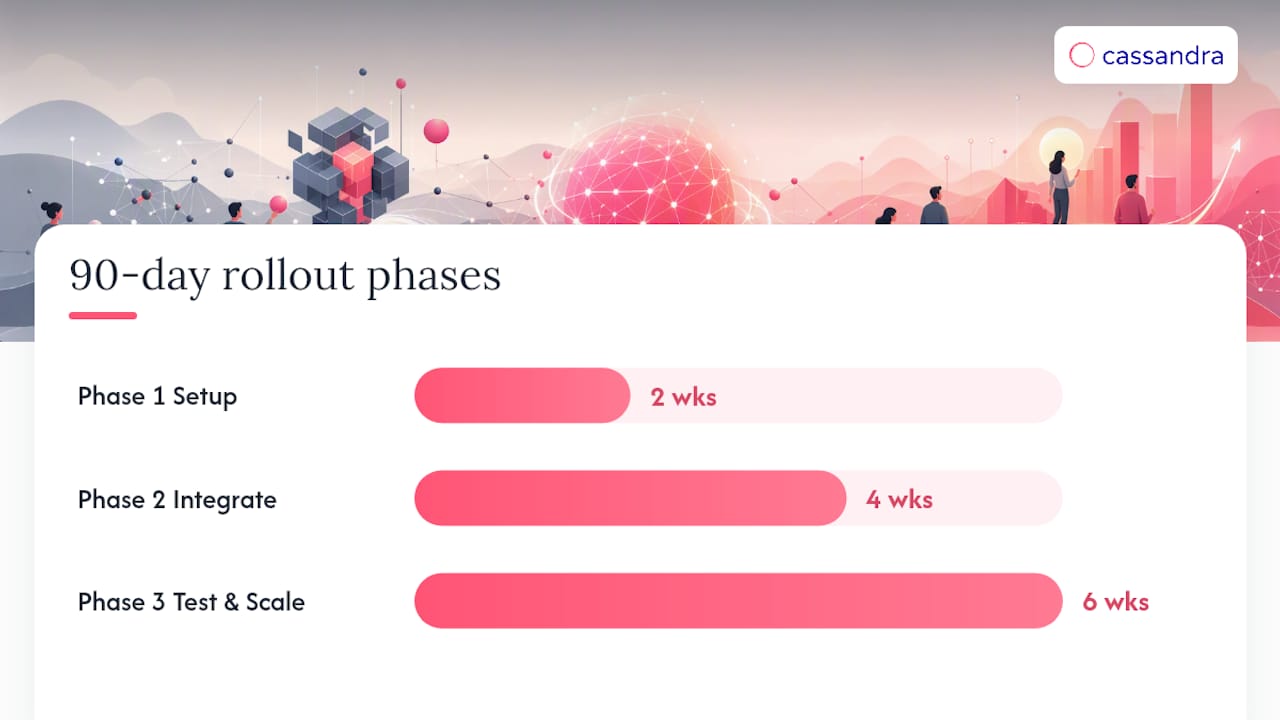
- Implementation typically takes around 12 weeks, involving data source inventory, integration, baseline validation, and controlled incrementality testing.
- Prioritizing connector breadth, true integration of measurement methods, and proof of impact is essential when evaluating platforms like Cassandra.
Table of Contents
- What Does a Marketing Engineer Platform Actually Do?
- How Does the AI Orchestration Layer Actually Work?
- What Business Outcomes Should You Expect?
- What Has to Be True Before You Automate?
- How Do You Evaluate an AI Marketing Engineer Platform?
- What Does a 90-Day Rollout Actually Look Like?
- What This Shift Means for Media Teams
- See How Cassandra Fits Your Evaluation Checklist
- Sources
- FAQ
What Does a Marketing Engineer Platform Actually Do?
The term describes a specific stack of capabilities, not a vague AI upgrade to your existing tools. Each layer does a distinct job, and the layers only work when they're wired together.
Data ingestion comes first: the platform pulls raw performance data from every ad account, your CRM, and site events, then stitches identities across platforms so a single customer isn't counted three separate times. Measurement sits on top of that foundation, and it needs three distinct methods working in concert. Marketing mix modeling gives you the portfolio-level view of what's driving revenue across channels over time. Incrementality testing isolates causal impact, the counterfactual answer to "would this sale have happened anyway?" Attribution fills in path-level detail, showing which touchpoints preceded conversion.
- Execution: automated budget allocation, bid and placement adjustments, and creative generation with built in multivariate testing
- Closed-loop learning: measurement outputs feed directly back into the next round of budget and creative decisions
That last point separates a marketing engineer from a dashboard. A dashboard tells you what happened. A marketing engineer changes what happens next, and does it again the following day.
How Does the AI Orchestration Layer Actually Work?
The technical core is what the AIMx framework calls an integrated feedback architecture: instead of running MMM, multi-touch attribution, and incrementality testing as three disconnected reports, the AIMx framework synthesizes them into one orchestration layer that resolves disagreements between methods and outputs a single, evidence-backed recommendation per channel.
Underneath that layer sits infrastructure most teams underestimate: connectors to every ad platform, server-side tagging, conversion sync, and pipelines that keep measurement current rather than stale by a reporting cycle.
Not every decision gets automated the same way. The platform typically separates recommendations from actions in three stages:
- Read-only analysis, where the system surfaces findings but takes no action
- Recommended changes, where a human approves before execution
- Gated automation, where low-risk, well-validated decisions execute automatically under monitoring
Industry reporting on programmatic buying confirms this staged pattern is now standard practice, with marketers prioritizing guardrails over full autonomy while infrastructure matures.
Pro Tip: Ask any vendor to show you exactly where the line sits between "the AI suggests" and "the AI executes." If they can't draw that line clearly, the guardrails probably don't exist yet.
What Business Outcomes Should You Expect?
The evidence for speed gains is direct: 73% of marketers say traditional measurement tools deliver insights too slowly to act on, and early deployments of unified, AI-native measurement platforms have shown business outcome improvements of 17% or more.
The core finding: Integrated measurement doesn't just report faster, it reduces the decision fragmentation that comes from three teams trusting three different attribution numbers for the same campaign.
Beyond speed, expect gains in specific operational areas:
- Allocation efficiency, since budget decisions draw on triangulated evidence rather than a single, often biased, attribution model
- 24/7 management, removing the lag between an insight surfacing and a human being available to act on it
- Faster creative cycles, with AI content marketing platform driven multivariate testing compressing weeks of manual iteration into days
Track blended ROAS, incremental revenue, time-to-insight, and experiment win rate as your primary scoreboard. Vanity metrics like impressions or click-through rate tell you activity happened. They don't tell you whether it made money.
What Has to Be True Before You Automate?
Automation amplifies whatever data quality already exists, good or bad. Conversion lag, platform-reported metrics that inflate their own contribution, and inconsistent event definitions across teams will all get automated faster and at greater scale if you don't fix them first.
Three infrastructure priorities matter most before you hand decisions to a system:
- Server-side tagging that survives browser privacy restrictions and ad blockers
- Identity stitching that connects the same customer across devices and platforms
- Consistent event definitions so "conversion" means the same thing in every data source
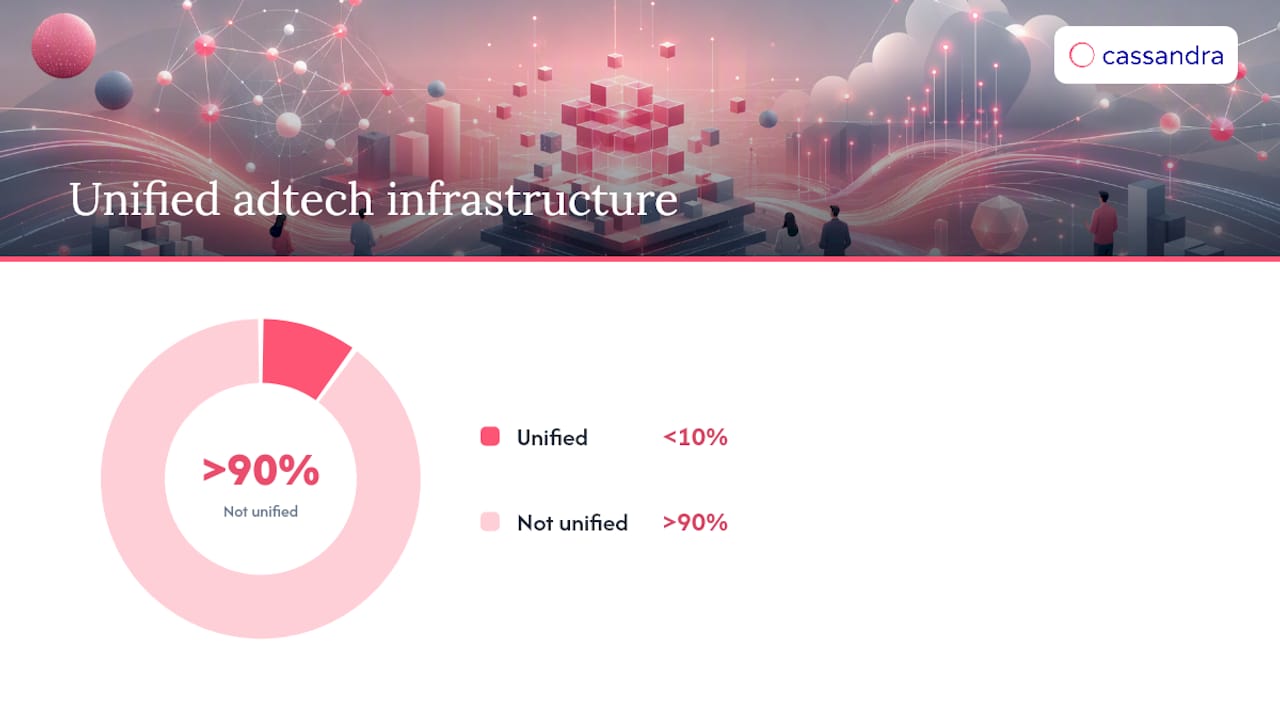
Fewer than 10% of advertisers currently have unified adtech infrastructure for true cross-channel orchestration, which is why plumbing work, not model sophistication, is usually the actual bottleneck.
It's a signal to run an incrementality test and settle the dispute with a controlled experiment.*
Governance failures show up as confidently wrong decisions scaled across every campaign at once, which is precisely what staged automation and escalation thresholds exist to prevent.
How Do You Evaluate an AI Marketing Engineer Platform?
Procurement for this category should run through the same evaluation criteria every time, regardless of vendor pitch decks.
Prioritize these in order:
- Connector breadth across your actual ad platforms, CRM, and analytics stack, not just the major three
- True MMM and incrementality integration, not measurement methods bolted together after the fact
- Closed-loop proof, meaning documented cases where measurement output changed a budget decision and that decision was validated afterward
- Data governance and security standards suitable for your CRM and revenue data
- Support SLAs that match your team's actual response-time needs, not a generic tier
Ask every vendor directly: What's the realistic time-to-value? Can you show a specific example of measured impact, not a case study summary? What rollback controls exist if an automated decision underperforms?
Pricing should scale with your media spend tier and the features you need. Pricing for AI marketing engineer platforms typically scales with media spend tier and features rather than charging a flat rate regardless of account complexity.
Be wary of any vendor claiming unchecked autonomy with no measurement evidence behind it, or one that can't explain how its model governance actually works when pressed.
What Does a 90-Day Rollout Actually Look Like?
A realistic implementation runs in three phases, and skipping ahead is the most common way teams get burned.
- Weeks 0 to 2: Inventory every data source, align on which KPIs actually matter, and set the guardrails before selecting one contained test use case.
- Weeks 2 to 6: Connect ad platforms and CRM, implement server-side events, and validate that baseline measurement is stable before adding complexity.
- Weeks 6 to 12: Run your first incrementality tests, calibrate MMM baselines against real experiment results, and enable only low-risk automations under active monitoring.
Governance doesn't end at week 12. Set a reporting cadence, define rollback rules in advance, and schedule ongoing model validation as a standing calendar item, not an afterthought triggered by a problem.
Pro Tip: Pick your first test use case for its measurability, not its size. A small, cleanly measured win builds internal trust in the system faster than a large, ambiguous one.
What This Shift Means for Media Teams
The job is changing from executing campaigns to directing and validating a system that executes them. That requires new skills: reading MMM output critically, designing incrementality tests, and knowing when a recommendation deserves a human veto.
Teams that succeed expand automation gradually, moving a single channel from read-only to gated automation only after several validated cycles, never all channels at once. One media team I'd point to as a model kept its highest-spend channel on manual approval for two full months after automating a smaller one first, and used that gap to build genuine trust in the system's recommendations.
— Gabriele Franco
See How Cassandra Fits Your Evaluation Checklist
Cassandra is the marketing engineer built to close the loop that most AI marketing tools leave open. It connects your ad accounts and sales data, runs proprietary marketing mix modeling, and pairs every budget decision with incrementality testing and attribution, so you get one verdict per channel instead of three conflicting reports. Where most AI agents move fast but can't prove impact, Cassandra ties every automated decision back to measured revenue, and it has influenced $1.86 billion in advertising investment doing exactly that.
If you're evaluating platforms against the checklist above, look at how Cassandra's pricing scales from Essentials through Enterprise based on your media spend and feature needs, then request a walkthrough of the platform to see the closed-loop system in action on your own account.
Sources
- Accenture Song Launches Accenture Marketing Investment Navigator, a First-of-Its-Kind AI-Native, Enterprise-Scale Unified Measurement Platform
- The AIMx framework: integrating marketing mix modeling, attribution, and AI-driven analytics for adaptive decision systems
- Marketers put up guardrails as AI agents reshape programmatic buying
- AI agent ad management: the hard part
FAQ
What Is the Difference Between a Marketing Engineer and Marketing Ops?
Marketing ops manages the tools, processes, and campaign workflows a team uses day to day. A marketing engineer is the AI system itself, connecting data, running measurement, and executing budget decisions autonomously under guardrails rather than supporting a human-run process.
Is a Marketing Engineer the Same as a Growth Marketer?
No. A growth marketer designs strategy and tests hypotheses manually across the funnel. A marketing engineer platform automates the measurement and execution layer, including MMM, incrementality testing, and budget allocation, so growth decisions rest on causal evidence rather than intuition alone.
How Much Does an AI Marketing Engineer Platform Cost?
Cassandra's pricing starts at €3,000 per month for the Essentials tier, with Complete from €3,750 and Scale from €5,400, scaling by feature depth and media spend. Enterprise pricing is available on request.
Can AI Agents Fully Manage Ad Spend Without Human Oversight?
Not reliably yet. Industry reporting shows agencies keep humans in the loop for transaction-critical bidding decisions, using staged automation with escalation controls rather than granting full autonomy from day one.
What Data Do I Need Before Adopting a Marketing Engineer Platform?
You need connected ad platform accounts, CRM data, and server-side event tracking with consistent conversion definitions across sources. Without that foundation, measurement outputs will be unreliable regardless of how sophisticated the AI layer is.