
Unified marketing measurement (UMM) combines marketing mix modeling, multi-touch attribution, and incrementality experiments into one statistically linked framework, so every budget decision uses a single source of truth instead of three conflicting ones. The payoff is concrete: teams that calibrate their models this way report higher revenue growth and reallocate spend with far more confidence. As cookieless targeting and privacy rules erode platform-level tracking, UMM has moved from a nice-to-have to the only defensible way to prove what marketing actually does.
TL;DR:
- Uniform calibration of MMM, MTA, and incrementality tests relies heavily on continuous Bayesian model updates to reflect new causal evidence.
- Most marketers combine quarterly MMM refreshes with rolling experiments, especially on contested channels, to maintain calibration accuracy.
- Offline channels and privacy-compliant data are integrated as aggregated inputs into MMM, not as detailed user-level touchpoints.
- A shared KPI, such as incremental revenue within a confidence interval, anchors cross-functional measurement and budget decisions.
- Cassandra platform automates the calibration process, reducing the need for extensive data science, and supports faster, more reliable measurement updates.
Table of Contents
- What Is Unified Marketing Measurement, and How Is It Different?
- What Do MMM, MTA, and Incrementality Testing Each Contribute?
- How Does Model Calibration Actually Work?
- What Business Value Does UMM Actually Deliver?
- What Are the Steps to Implement Unified Marketing Measurement?
- What Data and Privacy Constraints Should You Plan For?
- What Mistakes Undermine Unified Marketing Measurement?
- How Does Cassandra Support This Roadmap?
- Where Is Measurement Headed Over the Next 18 Months?
- A Platform-Led Path to Unified Marketing Measurement
- Where to Read More on Marketing Measurement
- Sources
- FAQ
What Is Unified Marketing Measurement, and How Is It Different?
Unified marketing measurement is a structural approach: instead of running marketing mix modeling, multi-touch attribution, and incrementality testing as three separate workflows, you link them so each one informs and corrects the others. Some practitioners call this measurement orchestration or an integrated marketing analytics stack. The label matters less than the mechanic. Information flows between models rather than sitting locked in three disconnected dashboards.
Contrast that with the siloed default most teams still run:
- A performance team pulls MTA numbers that credit last-click channels heavily.
- A brand team runs an annual MMM study that tells a different story about upper-funnel spend.
- Nobody reconciles the two, so budget meetings turn into arguments about whose model is right.
That siloed pattern produces contradictory answers to the same question: did the campaign work? UMM exists precisely to eliminate that contradiction by forcing the models to agree, or at least to disagree in a way you can quantify. This need has intensified as cookie deprecation and app-tracking restrictions strip away the granular, deterministic signals that MTA depended on. Google's own framing treats UMM less as a new tool purchase and more as a measurement foundation you build once and refresh continuously.
What Do MMM, MTA, and Incrementality Testing Each Contribute?
Each method answers a different question, and confusing them is the fastest way to misread your data. Here is how the three typically divide labor inside a unified framework:
- Marketing mix modeling (MMM) answers the strategic question: how does spend across channels, seasonality, pricing, and macro factors relate to revenue over time? MMM runs on aggregated, privacy-safe data and works even without user-level tracking, which is why it has become the backbone of cookieless measurement. Most teams refresh MMM quarterly or monthly; leading marketers now refresh it far more often using automated pipelines.
- Multi-touch attribution (MTA) answers the tactical question: which touchpoints, creatives, and audiences are performing this week? MTA is granular and fast, useful for in-flight optimization of a paid social campaign or an email send, but it inherits every bias baked into whatever tracking signal survives in a given browser or device.
- Incrementality experiments answer the causal question: what happens to outcomes if this channel simply stopped spending? Geo-holdouts, ghost ads, and matched-market tests strip out correlation and show true lift. They're the slowest and most resource-intensive of the three, but they're the only method that produces ground truth.
The practical rule: lean on MMM for the annual budget conversation, MTA for weekly optimization, and incrementality tests to settle disputes between the two. Guides on triangulating MTA, MMM, and incrementality testing walk through this division in more depth.
How Does Model Calibration Actually Work?
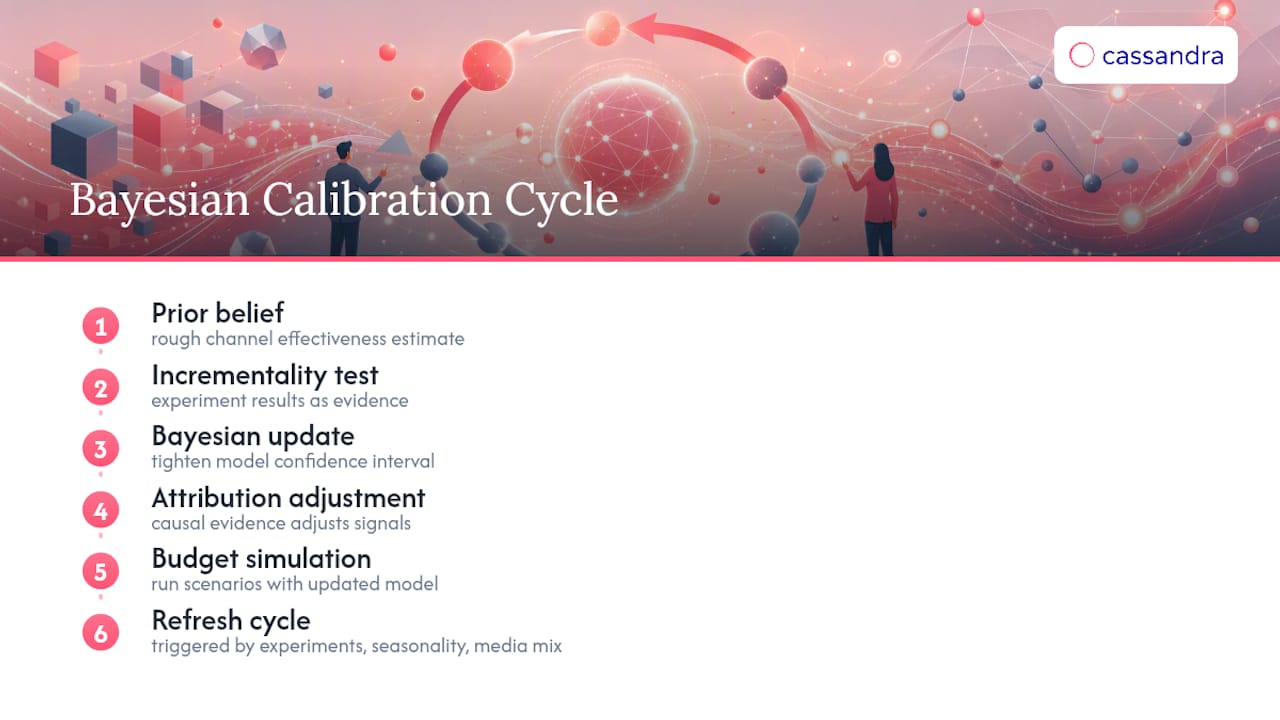
The technical trick behind UMM is Bayesian model linking, and it's less intimidating than it sounds. A Bayesian model starts with a prior belief, a rough estimate of a channel's effectiveness, and updates that belief as new evidence arrives. In a unified framework, the "new evidence" is your incrementality test results.
Rather than picking one number and ignoring the other, the unified model treats the experiment result as a calibration input, tightening the MMM's confidence interval around the number the causal test actually observed. Practitioners typically implement this by feeding experiment results in as priors inside a hierarchical Bayesian structure, so attribution signals get adjusted by causal evidence before they inform any budget simulation.
This isn't a one-time fix. Models need continuous learning: a refresh cadence triggered by new experiment data, seasonal shifts, or meaningful changes in media mix. BCG's research found that leading marketers are roughly twice as likely to embed AI into this refresh cycle, running faster MMM updates and scenario planning that would be impractical to do by hand. The organizations that treat calibration as a quarterly event, rather than a continuous one, fall behind fast.
What Business Value Does UMM Actually Deliver?
The clearest evidence comes from a documented case in the Think with Google unified measurement whitepaper, where blending MMM, MTA, and experiments led a retailer to reallocate budget toward upper-funnel media. The result was a 40% expected uplift in top-line sales, a gain the platform-reported metrics alone would never have surfaced, because last-click attribution routinely undervalues upper-funnel channels like video and social.
That's the mechanism worth understanding: UMM doesn't just make measurement more accurate, it changes where money goes. Budget allocation decisions that used to rely on whichever model the loudest stakeholder trusted now rely on a reconciled number every function can defend.
BCG's 2025 research found that about 40% of leading marketers already use incrementality results to calibrate their MMM outputs, and that group reports stronger revenue growth than peers still running siloed models. The same research treats a shared KPI as a "currency," a single agreed metric that finance, media buying, and brand teams all reference in the same conversation. Without that shared currency, a media buyer optimizing for last-click conversions and a CFO tracking marketing-attributed revenue are often arguing about two different numbers without realizing it.
Bringing UMM into conversations with finance and leadership means walking in with a confidence interval, not a point estimate. Instead of claiming "paid social drove $2 million in revenue," a mature UMM output says "paid social drove between $1.4 million and $2.3 million in incremental revenue, calibrated against a March geo-test." That framing survives scrutiny in a way a flat attribution number never does. It also tends to change reporting cadence: fewer channel-by-channel weekly reports, more monthly cross-functional reviews where MMM, MTA, and experiment results get read side by side. Shopify's guidance on measuring marketing effectiveness makes a similar point about aligning metrics like CAC and CLV to funnel stage and business maturity rather than tracking every metric everywhere.
What Are the Steps to Implement Unified Marketing Measurement?
Standing up UMM is a sequencing problem more than a technology problem. Here's a realistic order of operations for an analytics team starting from siloed reporting:
- Align on a north-star KPI first. Before touching any model, get marketing, finance, and leadership to agree on the single outcome metric that matters, whether that's incremental revenue, customer acquisition cost, or contribution margin. HBS guidance is blunt about this: measurement without an agreed business outcome produces vanity metrics that nobody trusts under pressure.
- Inventory your data and identify gaps. Map what first-party data you own, what's aggregated from platforms, and where identity resolution breaks down across devices and channels.
- Choose your integration approach and refresh cadence. Decide whether MMM updates monthly or quarterly, and set the technical mechanism for feeding MTA and experiment data back into it. Resources on integrating MMM, incrementality, and attribution daily cover the operational cadence question in detail.
- Design and run validation experiments. Start with your highest-spend or most-contested channel, run a geo-holdout or matched-market test, and feed the causal result back as a calibration input.
- Set governance and staffing. Assign clear ownership: someone owns the north-star KPI definition, someone owns experiment design, and someone owns the model refresh pipeline. Most teams underestimate how much of this is a governance problem rather than a modeling one.
Pro Tip: Run your first incrementality test on the channel your team argues about most, not the one that's easiest to test. Calibrating your most contested budget line first builds internal trust in the whole framework faster than starting with a low-stakes channel nobody's fighting over.
What Data and Privacy Constraints Should You Plan For?
Identity stitching across devices gets harder every year, so first-party data collection, through logged-in experiences, loyalty programs, and clean rooms, needs to be a deliberate strategy rather than a byproduct. Gartner's guidance on data quality and governance treats this as a core measurement issue, not a side concern: a unified model built on inconsistent or poorly governed data will calibrate itself against noise.
Offline and low-signal channels, think direct mail, radio, in-store point of sale, don't disappear from a unified framework; they simply enter as aggregated inputs to MMM rather than as user-level touchpoints in MTA. That asymmetry is fine as long as your team treats MMM as the layer responsible for channels MTA can't see.
Privacy-compliant modeling increasingly relies on proxies: modeled conversions, aggregated geo-level signals, and differential-privacy-safe reporting APIs, rather than deterministic user paths. Experiment design has to adapt too. Smaller advertisers need longer test windows or coarser geographic splits to reach statistical power that used to come faster with granular tracking.

What Mistakes Undermine Unified Marketing Measurement?
Most UMM failures trace back to one of a handful of avoidable errors:
- No agreed north-star KPI. Teams build sophisticated models that answer a question nobody asked. Fix this before any technical work starts, not after.
- Over-reliance on platform-reported metrics. Ad platforms have every incentive to overstate their own contribution. Validate platform numbers against an independent incrementality test at least once per major channel per year.
- Underpowered or infrequent experiments. A single geo-test run once a year can't calibrate a model that needs quarterly updates. Build a testing calendar, not a one-off project.
- Overconfidence in point estimates. A model output of "$2 million incremental revenue" hides a wide confidence interval. Report ranges, and explain to stakeholders that uncertainty shrinks with more experiments, not with a fancier model.
How Does Cassandra Support This Roadmap?
Cassandra was built around the exact sequence outlined above: a platform that runs incrementality testing alongside marketing mix modeling, then uses those experiment results to calibrate the MMM automatically rather than leaving reconciliation to a spreadsheet. That closes the gap between causal ground truth and strategic budget planning without requiring a separate data science team to hand-build the Bayesian linkage described earlier.
This approach has been used to validate channel-level spend and correct budget allocations that platform-reported metrics had been misrepresenting for months. Continuous monitoring keeps the models current instead of waiting for an annual refresh, which matters more with each cookieless update that degrades tracking further.
Where Is Measurement Headed Over the Next 18 Months?
Expect AI-driven MMM refreshes to become standard rather than exceptional. BCG's data already shows leaders running scenario planning at a pace manual modeling can't match, and that gap will widen. Incremental testing will scale from occasional validation checks to an always-on practice embedded in monthly finance reviews. The organizational shift matters as much as the technical one: measurement stops being an analytics side project and becomes a standing item in how budgets get approved.
— Gabriele Franco
A Platform-Led Path to Unified Marketing Measurement
Cassandra gives teams a faster route to the framework this article just walked through: incrementality testing, marketing mix modeling, and model calibration running as one connected system instead of three separate projects stitched together by hand.
Building that Bayesian linkage from scratch typically takes a dedicated data science hire and months of validation work. Cassandra ships with the calibration loop already built, so the incrementality result you run this quarter feeds directly into your MMM's confidence intervals without custom engineering. Deployment can scale from self-serve setups for lean teams to fully managed engagements including expert analyst support running the experiment calendar alongside the client team. If you're evaluating what a unified framework looks like for your specific channel mix, the marketing measurement use cases page walks through outcomes across ecommerce, nonprofit, and travel brands, and it's the most direct next step for seeing whether a platform-led build fits your team's current stack.
Where to Read More on Marketing Measurement
For deeper reading beyond this playbook: BCG's six-step framework covers KPI alignment and implementation cadence. The Think with Google unified measurement whitepaper documents the case-study uplift referenced above. HBS Online covers KPI benchmarking, and Gartner's data quality resources address governance under privacy constraints. For a broader look at funnel-stage metrics, see Shopify's marketing effectiveness guide on choosing KPIs by business maturity.
Sources
- Six Steps to More Effective Marketing Measurement | BCG
- Unified Marketing Measurement whitepaper | Think with Google (Objective Platform partnership)
- How to measure marketing effectiveness | HBS Online (blog)
- Gartner — Data quality and governance resources
FAQ
What Is Unified Marketing Measurement?
Unified marketing measurement is a framework that statistically links marketing mix modeling, multi-touch attribution, and incrementality experiments so they produce one consistent, calibrated view of channel performance instead of three conflicting reports.
How Is UMM Different From Traditional Attribution?
Traditional attribution relies on a single method, usually MTA, and reports its numbers in isolation, while UMM cross-checks those numbers against MMM and causal experiments and adjusts the model when they disagree.
How Often Should You Refresh a Unified Measurement Model?
Most leading marketers refresh MMM monthly or continuously using automated pipelines, with incrementality tests run on a rolling calendar to keep calibration current, rather than relying on an annual study.
What Skills Does a Team Need to Run UMM?
You need someone who owns KPI definition and business alignment, an analyst comfortable with experiment design and statistics, and either an in-house data science resource or a platform like Cassandra that handles the Bayesian model linking directly.
Can UMM Handle Offline Marketing Channels?
Yes. Offline channels like direct mail and in-store promotions enter as aggregated inputs into the marketing mix model rather than as user-level touchpoints, which keeps them inside the unified framework even without individual tracking data.