

Omnichannel attribution measures how digital touchpoints, from search clicks to CTV impressions, drive both online conversions and offline outcomes like store visits, so marketers can allocate budget based on total impact rather than channel-isolated reporting. It matters because most media plans still credit only the last digital click, undercounting channels like out-of-home and connected TV. Certain platforms treat deterministic identifiers, store-visit data, and incrementality tests as the anchors for making this measurement trustworthy.
TL;DR:
- Cross-device identification is most reliable when based on deterministic data, such as logins or loyalty accounts, rather than probabilistic inference from signals like IP addresses.
- Store-visit data accuracy improves significantly when using building footprint polygons instead of centroid radii, especially in dense retail environments.
- Validating attribution results through geo-lift experiments and cross-checking with marketing mix modeling reduces bias and protects against budget misallocations.
- An effective omnichannel attribution setup requires standardized tracking plans, robust data pipelines, and validation via small incremental tests before large budget shifts.
- Relying solely on last-click or model-based attribution can inflate bottom-funnel channel importance, so combining experiments with modeling is essential for trustworthy decision-making.
Table of Contents
- What Is Omnichannel Attribution and Why Does It Matter?
- Which Attribution Model Fits Your Business Goals?
- How Do You Solve Cross-Device Identity for Attribution?
- How Is Store-Visit Data Captured and Cleaned?
- What Does an Omnichannel Attribution Setup Require?
- Which KPIs Actually Matter for Omnichannel Measurement?
- What Are the Biggest Challenges in Omnichannel Attribution?
- How Do Practitioners Validate Omnichannel Attribution Results?
- Where Should Teams Start With Omnichannel Attribution?
- How Cassandra Supports Validated Omnichannel Measurement
- Sources
- FAQ
What Is Omnichannel Attribution and Why Does It Matter?
Omnichannel attribution assigns credit for a conversion, whether it happens in a browser or at a cash register, across every channel a customer touched before acting. That distinction from multichannel reporting matters more than it sounds. Multichannel tracking typically watches each channel in its own silo: paid search gets its own dashboard, email gets another, and in-store visits rarely enter the picture at all. Omnichannel measurement forces those signals into one framework so a CTV campaign that drove foot traffic gets credit instead of being written off as a non-performer.
This reframing changes real decisions. A retailer might discover that display ads look weak in last-click reporting but are quietly driving a large share of store visits, which would flip a planned budget cut into a budget increase. A DTC brand testing new creative can see whether a variant lifts assisted conversions across devices, not just clicks on one platform.
Because model-based attribution can still misread correlation as causation, the highest-trust evidence comes from methods that test cause and effect directly:
- Incrementality tests that compare exposed versus unexposed audiences
- Marketing mix modeling (MMM) that estimates channel contribution using aggregated spend and outcome data over time
- Geo-lift experiments that isolate a channel's effect by region
Attribution models describe what likely happened. Incrementality and MMM confirm what actually happened.
Which Attribution Model Fits Your Business Goals?
No single model works for every business, and the choice depends on what decision the output needs to support.
- Single-touch models (first-click, last-click) are simple but systematically overweight one moment in the funnel. Last-click, in particular, tends to inflate the value of bottom-funnel channels like branded search while starving the upper-funnel channels that created the demand in the first place.
- Multi-touch attribution (MTA) spreads credit across several touchpoints using rules like linear or time-decay weighting. It's an improvement over single-touch, but rule-based weighting is still a guess about influence, not a measurement of it.
- Data-driven algorithmic models use machine learning to weight touchpoints based on patterns in historical conversion data. They need a substantial volume of conversions to train on and can still encode the same correlation bias found in the training data itself.
- Causal approaches, including incrementality testing and geo-lift holdouts, isolate a channel's true impact rather than allocating credit within an existing outcome, which is why they tend to outperform model-only attribution when the stakes involve reallocating real budget.
Pro Tip: Run a small incrementality test before making any attribution-driven budget cut larger than 15 to 20 percent of a channel's spend. If the model and the experiment disagree, trust the experiment.
Our guide to attribution model types breaks down configuration criteria in more depth for teams choosing between these approaches.
How Do You Solve Cross-Device Identity for Attribution?
Cross-device attribution hinges on whether you can prove the same person moved from a phone to a laptop to a store, or whether you're inferring it. Deterministic matching links devices through a shared identifier, typically a login, email, or loyalty account, and is treated as the most reliable foundation for cross-device measurement. Probabilistic matching instead infers a connection from signals like IP address, device type, and browsing patterns, which works at scale but carries a real margin of error.
Growing deterministic coverage is a practical, ongoing project rather than a one-time fix:
- Add login incentives or gated content that require account creation
- Implement single sign-on (SSO) across owned properties to keep users authenticated
- Use loyalty program enrollment prompts at checkout and in-app
Deterministic identifiers, built through logins and SSO, materially improve cross-device stitching accuracy compared with relying on probabilistic inference alone.
None of this happens without limits. Consent frameworks under GDPR and CCPA restrict what identifiers can be collected and how long they can be stored, and platform-level changes like Apple's App Tracking Transparency have already shrunk probabilistic matching's accuracy across mobile. First-party data, collected directly through owned logins and purchases, is now the most durable asset a measurement program can build.
How Is Store-Visit Data Captured and Cleaned?
Store-visit attribution connects a digital ad exposure to a physical visit using anonymized location data, and the accuracy of that connection depends entirely on the quality of two inputs: raw GPS pings and points-of-interest (POI) geometry.
Google's own store-visit reporting, for instance, validates its modeled visit estimates using a panel of more than 10 million volunteers who opt into location tracking, a reminder that even platform-scale attribution leans on sampled ground truth rather than a complete census of every visit.
Geometry choice changes accuracy substantially. A centroid radius (a circle drawn around a store's map coordinate) is fast to compute but misfires constantly in strip malls, food courts, and multi-story buildings, where several storefronts sit within the same radius. Building footprint polygons, which trace a store's actual physical boundary, produce far more reliable attribution in dense retail environments.
Before any geospatial join happens, raw location data needs cleaning:
- Filter out pings with poor horizontal accuracy or implausible speed
- Detect stationary clusters that indicate a genuine dwell, not a drive-by
- Apply machine learning models using temporal and business-category context to disambiguate overlapping storefronts
Removing spurious pings and clustering before the POI join is a prerequisite, not an optional refinement, for any store-visit number a marketing team plans to act on.
What Does an Omnichannel Attribution Setup Require?
Launching omnichannel measurement is a sequencing problem as much as a technical one. Skip a step and the data downstream inherits the gap.
- Build the tracking plan first. Standardize UTM parameters across every channel, move critical events to server-side tracking to survive browser restrictions, assign consistent user IDs wherever authentication exists, and capture consent status at the point of collection.
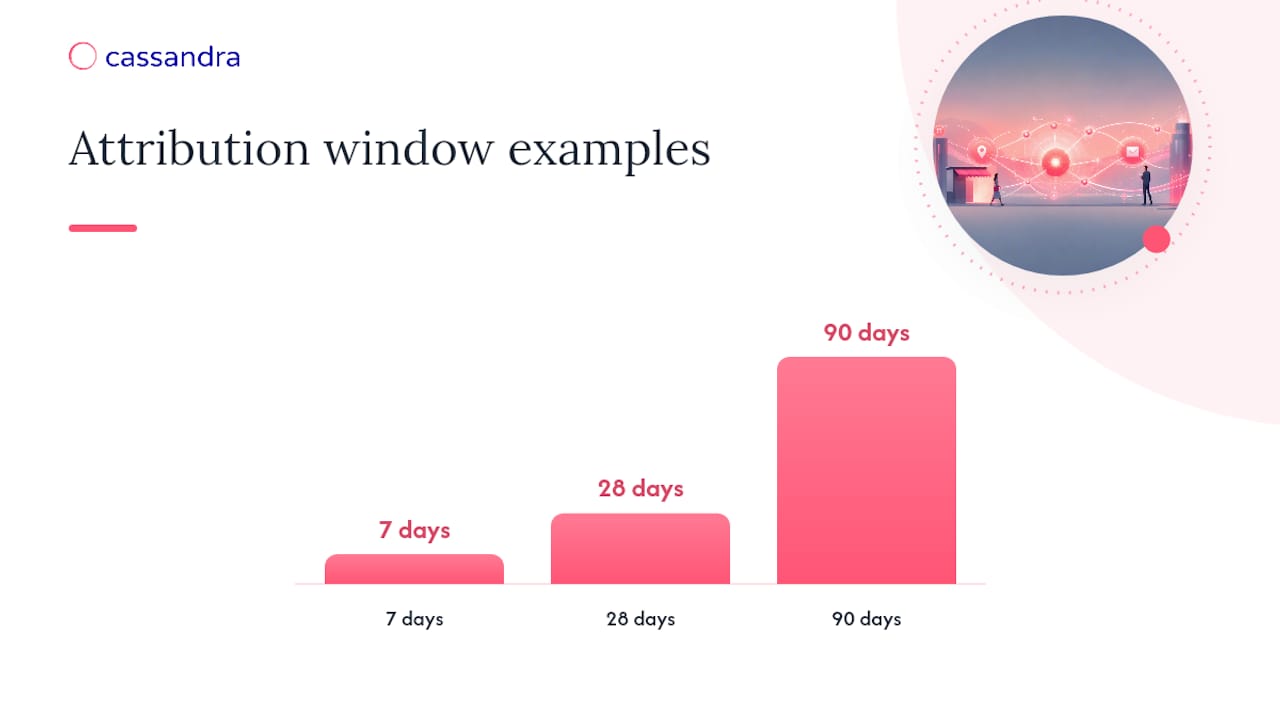
- Build the pipeline second. This means cleaning raw event and location data, joining store visits to POI geometry, stitching identities across devices, and defining attribution window rules (commonly 7, 28, or 90 days depending on purchase cycle length).
- Validate before you trust it. Run a contained incrementality test on one channel, compare the result against your marketing mix model's estimate for that same channel, and sanity-check exposed versus unexposed cohorts to confirm the lift is real and not an artifact of seasonality.
Pro Tip: Validate on your smallest, cheapest channel first. A failed experiment on a $5,000 test budget teaches you the same lesson as a failed experiment on $500,000, without the same downside.
For teams building this pipeline, our cross-channel measurement guide walks through instrumentation choices in more detail, and Klaviyo's own documentation on configuring omnichannel attribution is a useful illustration of how differently two platforms can define the same metric.
Which KPIs Actually Matter for Omnichannel Measurement?
The right KPI set for omnichannel attribution answers a decision, not a curiosity. Four metrics do most of the work:
- Incremental conversions or lift: the conversions that would not have happened without the channel, isolated through experimentation
- Attribution-weighted ROAS: return on ad spend adjusted for a channel's modeled or tested credit share, not its last-click share
- Store-visit lift: the incremental increase in physical visits attributable to a specific campaign or channel
- Cross-channel engagement rate: how often a customer interacts with more than one channel before converting, a signal of path complexity
Reporting these numbers responsibly means presenting a confidence range, not a single decimal-point figure, and flagging anywhere a model's estimate and an experiment's result disagree. When they do disagree, the experimental result should override the model. A reporting template built around this discipline typically pairs each KPI with its data source, its confidence level, and the specific decision it's meant to inform. Google explicitly recommends assigning store-visit conversions a value inside Smart Bidding strategies so upper-funnel formats like CTV and out-of-home can be credited for the offline sales they generate.
What Are the Biggest Challenges in Omnichannel Attribution?
Three problems recur across almost every omnichannel measurement program.
- Privacy and platform changes have shrunk the identifiers attribution used to rely on; Apple's App Tracking Transparency and the ongoing retirement of third-party cookies have both cut probabilistic matching accuracy on mobile.
- Coverage gaps split the customer base into an authenticated cohort you can measure with precision and an anonymous cohort you can only estimate, and blending the two without acknowledging the split difference in confidence produces misleading blended numbers.
- Model bias, especially last-click inflation, keeps assigning outsized credit to bottom-funnel channels and can trigger budget cuts to upper-funnel channels that were actually driving the demand.
The mitigation for all three is the same discipline: lean harder on first-party, authenticated data where you have it, and use incrementality testing as a guardrail before any model-driven number changes real spend.
How Do Practitioners Validate Omnichannel Attribution Results?
Geo-lift and holdout experiments remain the closest thing to a gold standard for validating attribution, because they measure what happened to a control group that saw no exposure against a group that did. Triangulating that experimental evidence against MMM output, rather than trusting either signal alone, reduces the risk of a large budget reallocation based on one biased number.
Store-visit validation follows the same logic: define an exposed group and a matched unexposed group, apply the POI geometry standards covered earlier, and compare visit rates between the two over a fixed window.
The strongest measurement programs never ask a single method to carry the whole decision. A model suggests where credit belongs; an experiment confirms whether that credit is real.
- Run geo-lift tests before scaling any new channel
- Compare MMM and MTA outputs quarterly, not once a year
- Treat disagreement between methods as a signal to test further, not a tiebreaker to ignore
One platform's approach to triangulating MTA, MMM, and incrementality testing follows this same sequencing.
Where Should Teams Start With Omnichannel Attribution?
Start with the cohort you can measure precisely: authenticated users with deterministic IDs. Run one small incrementality test before touching a real budget line, and let that experimental result, not a model's confidence score, justify a major reallocation. Measure toward a decision you're actually prepared to make. A metric nobody will act on isn't worth building a pipeline for.
— Tools
How Cassandra Supports Validated Omnichannel Measurement
Some platforms give teams a faster path from "the model says X" to "we tested it and confirmed X." Instead of stitching together a separate MTA tool, a separate MMM vendor, and a manual spreadsheet for geo-lift results, some run incrementality testing, marketing mix modeling, and cross-channel analytics inside one platform, so the triangulation this article recommends happens by default rather than as a quarterly scramble.

Organizations across various sectors have used this combination to catch budget misallocations that last-click reporting missed entirely, redirecting spend toward channels that were actually driving incremental orders. If your team is ready to move past model-only attribution, explore Cassandra's use cases across sectors or look into geo-lift incrementality testing as a starting point for your first validation run.
Sources
- Store Visit Attribution: Methods, Data & How It Works — SafeGraph
- Cross-Device Attribution: Tracking Users Across All Touchpoints — Amplitude
FAQ
What Does Omnichannel Mean in Simple Terms?
Omnichannel means treating every channel a customer uses, online and offline, as part of one connected experience rather than measuring or managing each one separately.
What Are the Four C's of Omnichannel?
Definitions vary across sources, but a common framing centers on consistency, convenience, coordination, and the customer, meaning the experience should feel unified across every touchpoint a customer chooses to use.
What Is an Example of Omnichannel Marketing?
A shopper sees a connected TV ad, later searches the brand on their phone, then visits a physical store to complete the purchase. Omnichannel attribution is what connects that CTV impression to the in-store sale.
Can You Give an Example of Marketing Attribution?
A customer clicks a paid search ad, opens an email three days later, and converts on a third visit through direct traffic. A multi-touch attribution model would split credit across all three touchpoints instead of giving it entirely to the final click.
How Is Omnichannel Attribution Different From Multi-Touch Attribution?
Multi-touch attribution is one method within omnichannel attribution; it distributes credit across digital touchpoints, while omnichannel attribution also incorporates offline outcomes like store visits that multi-touch models alone typically can't capture.