

Use multi-touch attribution (MTA) when you need tactical, short-window insight into digital campaign performance, and use marketing mix modeling (MMM) when you need strategic, cross-channel budget guidance that survives cookie loss. Most mature organizations run both and settle disagreements with incrementality testing. If your digital conversion volume is high and your channel mix is mostly online, MTA alone may suffice. Once offline spend or brand campaigns enter the picture, MMM becomes necessary.
TL;DR:
- Use offline spend data and at least 12 to 24 months of historical information to ensure accurate modeling when choosing MMM over MTA.
- If your offline media share exceeds 20% or identity resolution is below 60%, MMM becomes essential for comprehensive measurement.
- MTA provides immediate, high-resolution insights for digital channel optimization but struggles with privacy changes and offline media, requiring high conversion volume.
- Combining MMM and MTA with incrementality testing helps validate insights and resolve model disagreements, especially in complex omnichannel environments.
- A 90-day plan should start with a data audit, followed by targeted experiments, to establish ownership and ensure effective hybrid measurement implementation.
Table of Contents
- MMM vs MTA at a Glance: The Axes That Actually Matter
- What Is Multi-Touch Attribution (MTA)?
- How Multi-Touch Attribution Works, Step by Step
- Benefits and Limitations of MTA
- What Is Marketing Mix Modeling (MMM)?
- How MMM Works: The Data Pipeline and Modeling Steps
- Benefits and Limitations of MMM
- Decision Thresholds: When to Choose MTA, MMM, or Both
- How to Run a Hybrid Stack and Validate With Incrementality Testing
- How Cassandra Operationalizes Hybrid Measurement
- Your 90-Day Starting Point for MMM vs MTA
- See How Cassandra Handles MMM and MTA Together
- Sources
- FAQ
MMM vs MTA at a Glance: The Axes That Actually Matter
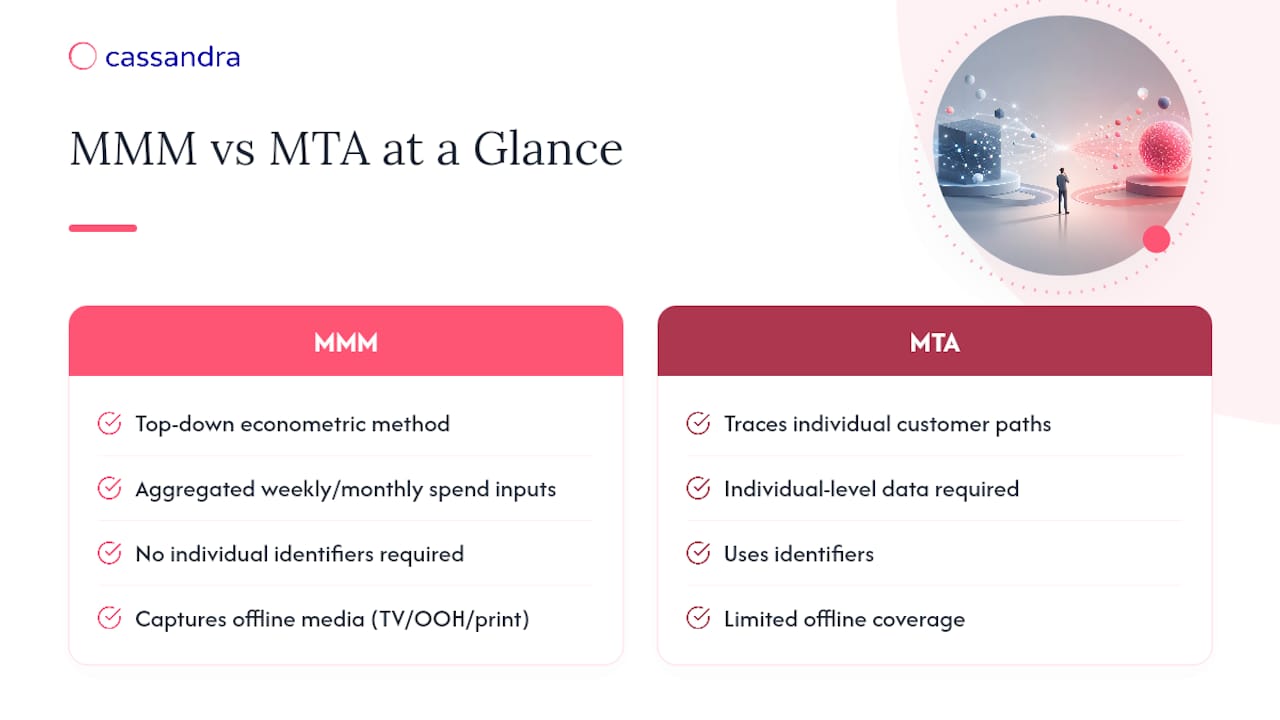
The MMM vs MTA decision usually comes down to five practical axes: what job you're solving, how much data you have, how durable that data is against privacy shifts, whether you need offline visibility, and how often you need answers.
- Best for: MTA fits campaign and creative optimization; MMM fits budget allocation and channel-level strategy.
- Data requirements: MTA needs granular, user-level identifiers and meaningful conversion volume; MMM needs at least a couple of years of weekly spend and outcome data.
- Privacy durability: MTA degrades as identity resolution weakens; MMM runs on aggregated data that cookie deprecation doesn't touch.
- Offline visibility: MTA is blind to TV, radio, out-of-home, and most offline media; MMM incorporates them natively through spend-and-outcome regression.
- Cadence: MTA reports daily or weekly; MMM typically refreshes quarterly.
A useful signal for which way to lean: MTA prioritizes precision and immediacy for digital optimization, while MMM emphasizes stability and long-term impact across channels. Neither claim cancels the other out. They're solving different problems, on different clocks, with different data. Once you accept that, the MMM vs MTA comparison stops looking like a rivalry and starts looking like a division of labor.
What Is Multi-Touch Attribution (MTA)?
Multi-touch attribution is a bottom-up measurement method that assigns fractional credit to each marketing touchpoint a customer encounters before converting. Instead of asking "how did overall revenue respond to our spend," MTA asks "which specific ad, email, or click contributed to this specific sale."
The method depends on user-level data: click IDs, impression logs, device identifiers, and first-party identity resolution tying a person's touches together into a single journey. Without that identity backbone, there's no path to credit; that's the core vulnerability we'll return to in the limitations section below.
Analysts use MTA outputs in fairly specific ways. Fractional credit models (linear, time-decay, position-based, or algorithmic) redistribute conversion value across the touchpoints in a path. Path reports show the sequences that actually precede conversion, which channels tend to open a journey versus close it, and where friction shows up. Creative and audience-level signals let media buyers see, within days, which ad variant or segment is pulling weight and which is dead spend. For an in-flight campaign optimization, multi-touch attribution is still the fastest read available. Its resolution is exactly what makes it fragile at scale, a tension every MMM vs MTA discussion eventually has to confront.
How Multi-Touch Attribution Works, Step by Step
Getting MTA into production follows a fairly consistent operational sequence, and where teams stall usually tells you which step needs the most engineering investment.
- Collect and unify identifiers. Pull together click IDs, impression logs, CRM data, and login events, then stitch them into a single customer identity wherever possible.
- Construct conversion paths. Sequence every touchpoint a user had before converting, ordered by timestamp, across every channel that logs an event.
- Choose a crediting model. Decide whether credit splits evenly (linear), weights recent touches more heavily (time-decay), favors the first and last touch (position-based), or is derived algorithmically from a trained model.
- Aggregate into reports. Roll individual paths up into campaign, channel, and creative-level dashboards that media buyers check weekly or daily.
The failure modes cluster around two things: identity gaps and volume. When a meaningful share of traffic can't be tied to a known user (a common outcome as browsers restrict third-party cookies and identifiers fragment), paths get truncated and credit gets distorted. And when conversion counts are thin, the model has too little signal to distribute credit reliably, so outputs swing week to week without any real change in performance.
Pro Tip: *Before you trust an MTA dashboard, check what percentage of conversions in the last 30 days have a fully resolved path.
Benefits and Limitations of MTA
MTA earns its place in the stack through speed and resolution, but it comes with real structural constraints that no amount of engineering fully solves.
Where it delivers:
- Fast feedback loops. You can see performance shifts within a day or two, not a quarter.
- Creative and audience granularity that no top-down model can replicate.
- High-resolution signals for in-platform optimization: which ad, which placement, which segment.
Where it breaks down:
- Fragile under identity loss. As identifiers disappear, path completeness drops and credit allocation gets noisier.
- Blind to offline media and to long consideration windows common in high-ticket or B2B sales cycles.
- Requires meaningful conversion volume to produce stable output; low-volume advertisers get unreliable fractional credit.
- Engineering and governance overhead: identity resolution, tagging discipline, and ongoing maintenance as platforms change their data-sharing rules.
None of this makes MTA obsolete. It makes it a tool with a specific job: tactical, in-flight, digital-channel optimization, not the final word on what's driving business outcomes.
What Is Marketing Mix Modeling (MMM)?
Marketing mix modeling is a top-down econometric method that estimates how aggregate marketing activity, alongside external factors, drove business outcomes over time. Rather than tracing individual customer paths, MMM regresses weekly (or monthly) spend by channel against sales, sign-ups, or whatever outcome matters, controlling for seasonality, pricing, competitor activity, and macroeconomic variables.
The typical inputs are aggregated: weekly spend by channel across digital and offline media, the outcome metric you're modeling, and external regressors like weather, holidays, or promotions. No individual-level identifiers are required, which is precisely why MMM holds up as privacy regulations tighten.
The outputs are strategic rather than tactical: response curves showing how each channel's contribution changes as spend increases (and where it saturates), and channel contribution estimates showing what share of outcomes each channel is realistically responsible for. Because MMM operates on aggregated data rather than individual tracking, it isn't affected by cookie deprecation or identity fragmentation the way MTA is, and it's the only one of the two methods that natively captures offline media like TV, out-of-home, and print. That combination, privacy durability plus offline coverage, is why MMM has become the anchor model for portfolio-level budget conversations.
How MMM Works: The Data Pipeline and Modeling Steps
Building a credible MMM is less about a single algorithm and more about assembling a clean, sufficiently long historical dataset and applying the right transformations before modeling begins.
- Assemble historical data. Most credible models need at least 24 to 36 months of weekly spend and outcome data across every major channel, including offline media where relevant.
- Preprocess and transform. Clean the series, align time windows, and apply transformations like adstock (modeling the decayed carryover effect of advertising) and diminishing-returns curves.
- Model the relationships. Regression techniques estimate each channel's contribution while controlling for seasonality, pricing changes, and external regressors like macroeconomic shifts or competitor moves.
- Validate the output. Check model fit, review confidence intervals around each channel's estimated contribution, and sanity-check results against known business events.
- Refresh on a set cadence. Rebuild the model roughly quarterly to reflect changing market conditions and updated data.
The statistical requirements are real. Building a defensible MMM takes someone comfortable with regression diagnostics, multicollinearity checks, and confidence interval interpretation, not just a dashboard user. That skill requirement is one reason many teams lean on measurement platforms to operationalize the modeling rather than building from scratch.
Benefits and Limitations of MMM
MMM's strategic value comes from what it can see that MTA can't, but it asks for patience and historical depth that not every organization has on hand yet.
Where it delivers:
- Measures offline and long-window brand effects that never show up in a click log.
- Robust to cookie and identifier loss because it never depended on user-level tracking in the first place.
- Produces defensible, board-level answers to "where should our next marketing dollar go."
Where it breaks down:
- Needs a long historical data series; a business with 12 months of clean data or fewer will get shaky, low-confidence estimates.
- Slower cadence. Quarterly refreshes mean MMM can't tell you what happened to yesterday's campaign.
- Requires real statistical skill to build and interpret correctly, which raises the resourcing bar.
- Can mislead when history is too short or when a sudden market shock (a pandemic, a major pricing change, a new competitor) breaks the historical relationships the model was trained on.
The right way to read MMM's limitations isn't "it's less accurate than MTA." It's that MMM answers a different question, on a different timescale, using different assumptions, and those assumptions need enough history to hold.
Decision Thresholds: When to Choose MTA, MMM, or Both
The MMM vs MTA choice gets much easier once you translate it into measurable gates instead of a philosophical debate. Run these checks against your own data before deciding.
- Conversion volume: If you're generating fewer than a few hundred conversions a month in a given channel, MTA's fractional credit will be too noisy to trust; lean toward MMM for that channel.
- Offline spend share: If offline media (TV, out-of-home, print, radio) makes up more than roughly 15 to 20% of total spend, MTA is structurally blind to that portion, and MMM becomes necessary to see the full picture.
- Identity resolution rate: If fewer than 60% of conversions carry a fully resolved path, your MTA outputs are already compromised regardless of the model you layer on top.
- Historical data depth: If you have less than 12 months of clean, channel-level spend and outcome history, MMM confidence intervals will be too wide to act on; build the data foundation first.
- Sales cycle length: Long B2B or considered-purchase cycles stretch well beyond MTA's practical attribution windows, favoring MMM's aggregate view.
As a prioritized checklist: if offline spend is meaningful or your history is deep and clean, start with MMM. If your channel mix is digital-dominant with strong conversion volume, MTA can run standalone for tactical decisions. If neither condition clearly wins, or if your channel mix spans both, run both and treat disagreements between them as a signal to test, not a tiebreaker to ignore. Practitioner guidance consistently points to spend levels, channel mix, and conversion volume as the concrete gates worth measuring before committing budget to either build.
Governance matters here too. Media buyers and channel owners should own MTA's weekly optimization decisions; a centralized analytics or measurement team should own MMM's quarterly allocation recommendations, with clear escalation when the two conflict.
Pro Tip: Run these five checks against last quarter's data before your next planning cycle, not during it. Finding out you're below the identity-resolution threshold mid-quarter forces reactive decisions instead of planned ones.
How to Run a Hybrid Stack and Validate With Incrementality Testing
Running MMM and MTA together isn't complicated in concept: MMM sets the strategic envelope, MTA optimizes within it, and incrementality testing settles disputes between the two. The complexity is in the operational discipline required to make that division stick.
- Assign decision rights clearly. MMM outputs set quarterly budget envelopes by channel. MTA outputs guide weekly or daily in-channel decisions, like which creative or audience segment gets more spend within an already-approved envelope.
- Standardize your spend taxonomy. Both models need to reference the same channel definitions, campaign naming conventions, and time windows, or reconciling their outputs becomes a full-time translation exercise.
- Align on shared KPIs. Pick outcome metrics (revenue, orders, sign-ups) that both models optimize toward, so a "win" in MTA and a "win" in MMM mean the same thing to leadership.
- Design incrementality tests as the tiebreaker. Geo holdouts (suppressing a channel in select markets while running it elsewhere) and conversion lift tests give you a causal estimate that neither correlational method can produce on its own.
- Reconcile and iterate. When MTA and MMM disagree meaningfully on a channel's contribution, treat that gap as a hypothesis to test, not a modeling error to argue about.
Industry guidance is consistent on this point: neither MTA nor MMM should be treated as a single source of truth, and incrementality experiments provide the causal ground truth that resolves disagreements between them. The operational pattern that shows up repeatedly among teams that have this figured out: MMM runs quarterly to set portfolio envelopes, MTA runs daily or weekly to optimize inside them, and geo experiments run continuously in the background to check both.
For teams managing a mix that spans local and national campaigns, a structured media-planning checklist helps keep offline and online budgets aligned to the same taxonomy before the MMM and MTA outputs ever get compared. And if your channel strategy already spans multiple customer touchpoints, aligning measurement to an omnichannel structure from the outset avoids a lot of the reconciliation pain later.
Pro Tip: Start your first geo holdout on the channel where MTA and MMM disagree most, not on your best-performing channel. That's where the experiment will actually change a decision.
How Cassandra Operationalizes Hybrid Measurement
Some marketing measurement platforms combine multi-touch attribution, marketing mix modeling, and instant incrementality testing in one measurement environment, rather than asking analytics teams to stitch three separate vendors together and reconcile outputs manually.
That matters most for teams that recognize their channel mix spans both digital-heavy tactical decisions and offline, long-window brand investment, exactly the split where MMM vs MTA questions get contentious. Cassandra's measurement validation approach is built to let MMM set the strategic envelope while attribution and geo-lift experiments continuously check the model's assumptions against real, causal results. Cassandra has shown ROI improvements across sectors including fashion, nonprofit, and travel, with case studies documenting measurable gains in both ROI and order volume for clients making that shift.
Your 90-Day Starting Point for MMM vs MTA
Start with a data audit, not a model. Check your identity resolution rate, your offline spend share, and how many months of clean channel-level history you actually have. Those three numbers will tell you more about whether to prioritize MTA, MMM, or both than any framework will.
In the first 30 days, run the readiness checks above. In the next 30, launch one geo holdout on your most contested channel. By day 90, you should have enough evidence to assign clear ownership: MTA to campaign managers, MMM to a centralized analytics function, and experiments to whoever adjudicates disagreements between them.
— Tools
See How Cassandra Handles MMM and MTA Together
Choosing between MMM and MTA stops being a real dilemma once your measurement platform runs both natively and checks them against actual causal experiments instead of assumptions. Cassandra's marketing mix modeling sets your strategic channel envelopes, while its geo-lift incrementality testing validates what your attribution and mix models are telling you, closing the reconciliation gap this article walked through step by step.

Instead of stitching together separate MTA tools, spreadsheet-based mix models, and one-off experiment vendors, teams get a single environment built around the exact triangulation framework outlined above. If your channel mix spans digital and offline, or you're already seeing MTA and MMM disagree, explore Cassandra's marketing measurement use cases to see which starting point fits your current data maturity, and request a walkthrough of how the hybrid stack applies to your specific channel mix.
Sources
- MTA vs MMM: How to set up marketing measurement in a privacy-first world
- MTA vs. MMM: Which marketing attribution model is right for you?
- MTA vs. MMM: What's the difference? | TechTarget
- MMM vs MTA: When to Use Each Method in 2026
- MMM vs Multi-Touch Attribution: When to Use Which (and When to Use Both)
FAQ
When should you use MMM instead of MTA?
Use MMM when offline spend makes up a meaningful share of your budget, when you have at least 12 to 24 months of clean historical data, or when identity resolution has degraded to the point that MTA's path data is unreliable.
Is MMM the same thing as econometrics?
MMM is an applied econometric technique. It uses regression modeling, adstock transformations, and control variables borrowed directly from econometrics, but the term "MMM" specifically refers to its marketing application.
What's the difference between MMM and incrementality testing?
MMM is a statistical model that estimates channel contribution from historical, aggregated data, while incrementality testing (geo holdouts, conversion lift studies) runs a live experiment to measure causal impact directly. Incrementality testing is generally treated as the more reliable ground truth when MMM and MTA disagree.
What's the difference between the media mix and the marketing mix?
The "marketing mix" refers to the broader set of levers a business controls, including product, price, promotion, and placement. The "media mix" is narrower, referring specifically to the combination of paid, owned, and earned media channels a brand uses, which is what marketing mix modeling actually measures.
Can Cassandra replace both MTA and MMM tools separately?
Some platforms combine multi-touch attribution, marketing mix modeling, and incrementality testing in one environment, so teams don't need to reconcile outputs across multiple vendors to run the hybrid approach this article recommends.