
A marketing engineer stack is the connected set of systems, from CRM/CDP through data warehouse, integration layer, orchestration, and AI agents, that a marketing engineer builds so marketing decisions run on verified data instead of guesswork. The role exists to turn fragmented tools into a single automated system that proposes budget moves, launches tests, and proves what worked. Martech utilization sits at just 49% according to Gartner's 2025 survey, which means most teams already own the tools. What they lack is the engineering discipline to connect them safely.
TL;DR:
- Most teams lack the engineering discipline to connect their owned tools safely, despite owning a majority of martech solutions.
- Each layer of the marketing engineer stack must be precisely configured to support automation, including stable identities, proper event labeling, and error handling.
- Proper use of streaming, webhooks, and batch patterns depends on the decision frequency, with unique event keys essential to prevent double-counting.
- Combining attribution, MMM, and incrementality testing into a unified system produces more trustworthy insights than treating them separately.
- Building or maintaining a reliable, end-to-end automated stack requires versioned harnesses, read-back checks, and approval gates to ensure trust and explainability.
Table of Contents
- What Is the Marketing Engineer Stack, Layer by Layer?
- How Do You Configure Each Stack Layer for Automation?
- Streaming, Webhooks, or Batch: Which Integration Pattern Fits?
- How Do Attribution, MMM, and Incrementality Work Together?
- Should You Hire a Marketing Engineer or Marketing Ops?
- What Does the Marketing Engineer Stack Look Like in Practice?
- What Most Teams Get Wrong About This Stack
- A Managed Path to This Stack: Cassandra
- Sources
- FAQ
What Is the Marketing Engineer Stack, Layer by Layer?
Every credible 2026 architecture converges on five layers, a pattern documented across current marketing engineer tech stack guides. Each layer has a distinct job, and confusing them is where most stacks break down.
- CRM/CDP layer: Holds identity and customer profiles; for example, ZinCRM provides flexible CRM capabilities essential for API-first automation and identity stitching. Salesforce, HubSpot, and Segment live here, feeding canonical records to everything downstream.
- Data warehouse layer: The single source of truth. Snowflake or BigQuery store raw and transformed events that every other layer reads from and writes back to.
- Integration/iPaaS layer: Moves data between systems. Zapier, Workato, or custom middleware handle schema mapping, retries, and error routing.
- Orchestration/automation layer: Where rules, campaigns, and proposed actions get sequenced, gated, and approved before anything goes live.
- AI agent layer: Executes bounded tasks, drafts creative, adjusts bids, flags anomalies, inside guardrails the orchestration layer enforces.
Data flows upward from capture into the warehouse, sideways through integrations, and back down as decisions. Approvals belong in orchestration, never buried inside an agent's own logic. That separation is what keeps an autonomous system auditable.
Agent readiness cuts across all five layers rather than living in any one of them. A CRM with rigid API rate limits or a warehouse with no row-level audit trail will bottleneck agents no matter how well the orchestration layer is designed. Before adding any AI agent, check whether the layers beneath it can actually support machine-speed requests without breaking.
How Do You Configure Each Stack Layer for Automation?
Each layer needs specific configuration choices to become agent-safe, not just functional. Here is what to get right at each stage, and what happens when you don't.
-
Sources and capture. Every event needs a consistent shape: timestamp, source, campaign ID, and a provenance tag showing where it originated. Skip labeling and you'll spend months later trying to reconcile which platform actually generated a conversion. Server-side tagging, as Google's own documentation on server containers explains, gives you centralized control over event routing and shaping before data ever reaches an analytics endpoint, which matters enormously once privacy rules start clipping browser-side signals.
-
CRM/CDP. The canonical key, usually a hashed email or a persistent device ID, has to be stable across every system that touches it. If your CRM and your ad platform use different identity resolution logic, your attribution numbers will never reconcile. Demand API-first access with webhook support; a platform that only offers CSV exports cannot participate in automation.
-
Warehouse and ETL. Canonical tables need clear ownership: one table for orders, one for sessions, one for ad spend, each partitioned by date for query performance. Transformations should be version-controlled, not buried in a business intelligence tool's proprietary layer, so a change to logic is reviewable like code.
-
iPaaS and integration. Mapping patterns should handle both the happy path and the failure path. Define what happens when a field is missing, when a schema changes upstream, or when a call times out. Retries need backoff logic, not infinite loops.
-
Orchestration. This is where proposals get gated. An agent recommending a 20% budget shift should generate a proposal object, not an executed change, until a human or a pre-approved rule confirms it. Read-back verification, confirming the action actually happened and produced the expected data change, closes the loop.
-
AI agents. Sandbox every agent before production. Idempotence matters here specifically: if an agent's request to pause a campaign gets sent twice because of a network retry, it should not pause the campaign twice or throw an unhandled error. Rate limits and a dedicated test harness catch this before it costs you real budget.
Pro Tip: Build one small, versioned test harness before your first production agent goes live. Feed it known inputs, check known outputs, and re-run it every time you change a connected system. This single habit catches more integration failures than any amount of manual QA.
Streaming, Webhooks, or Batch: Which Integration Pattern Fits?
The right pattern depends on how fast a decision needs to happen, not on which one sounds most modern. Real-time bid adjustments need streaming. Lead-status updates from a CRM fit webhooks well. Nightly warehouse rollups for MMM inputs are fine on batch, and forcing them into real time just adds fragile infrastructure for no benefit.
- Streaming suits high-frequency signals like ad platform spend pulls, where a five-minute lag can mean overspending on a paused campaign.
- Webhooks fit event-driven triggers: a form submission, a purchase, a support ticket closing, where near-instant reaction matters but volume is manageable.
- Batch works for aggregation tasks: daily attribution rollups, weekly MMM refreshes, anything where consistency across a full data set beats speed.
Idempotence has to be designed into every pattern, not bolted on afterward. Assign each event a unique key so replaying it, whether from a webhook retry or a batch rerun, never double-counts a conversion or double-charges a budget.
Before connecting any platform to an agent, check its error semantics, rate limits, and retry behavior. A platform without sandboxing or with vague error messages will make automation unreliable no matter how good your orchestration logic is. Track integration health with real service-level objectives: uptime, latency, and error rate per connection, reviewed the same way you'd review campaign performance.
How Do Attribution, MMM, and Incrementality Work Together?
Attribution, marketing mix modeling, and incrementality testing each answer a different question, and a marketing engineer stack needs all three feeding the same warehouse to produce a trustworthy verdict per channel. Attribution tells you which touchpoint a customer interacted with. MMM estimates channel contribution to revenue over time, using far less granular data but capturing offline and brand effects attribution misses. Incrementality testing isolates true causal lift through holdouts or geo experiments.
- Attribution runs continuously and cheaply, but overcounts channels with high touchpoint visibility.
- MMM needs longer time windows and larger data sets, but captures channels attribution undercounts, like TV or out-of-home.
- Incrementality testing is the most rigorous but the most operationally expensive, best reserved for validating your biggest budget decisions.
High performers treat these three methods as one system, not three competing dashboards. Composable, capability-driven measurement is exactly what Gartner's 2025 survey found separating high-performing marketing organizations from the rest.
Always-on incrementality patterns run smaller, continuous holdouts rather than one-off tests, feeding read-back checks that confirm a budget shift actually produced the lift a model predicted. None of this works without clean event labeling; a warehouse full of unlabeled spend and unlabeled conversions will make even the best model produce noise.
Should You Hire a Marketing Engineer or Marketing Ops?
Marketing engineers build new automated systems from scratch; marketing ops governs and runs what already exists. Hiring the wrong one for the job is one of the more expensive mistakes a growing team makes, since the two roles have genuinely different deliverables and skill sets.
- Look for SQL fluency, API integration experience, and comfort reading a data model, not just campaign management skills.
- Hire marketing ops when your stack is stable and needs governance; hire a marketing engineer when you need new automated systems built.
- Track time-to-first-agent (how fast a new automation goes from idea to production) and percent of spend instrumented as core KPIs.
- Require a single empowered approver for each automated decision type, with a versioned test harness behind every agent you ship.
What Does the Marketing Engineer Stack Look Like in Practice?
Four patterns cover most of what a marketing engineer stack actually does day to day.
- Paid media closed loop. Ad platform spend data streams into the warehouse, attribution and incrementality models score it, an orchestration layer proposes a budget shift, and read-back confirms the new spend landed and produced the predicted lift.
- Lead nurturing and identity stitching. Form fills and CRM records get matched on a canonical key, then routed into nurture sequences with consistent identity across every channel.
- Always-on incrementality. Small rotating holdouts run continuously across channels, feeding a live budget allocation model instead of one annual test.
- Creative performance loop. Underperforming ad creative gets flagged automatically, a new variant launches, and read-back verification confirms whether it actually improved on the metric that mattered.
What Most Teams Get Wrong About This Stack
The central artifact in any marketing engineer stack isn't a tool. It's the harness: a versioned, inspectable record of what an agent proposed, why, and what happened after. Teams that skip this end up with automation they can't explain and can't trust, which defeats the entire point of building it.
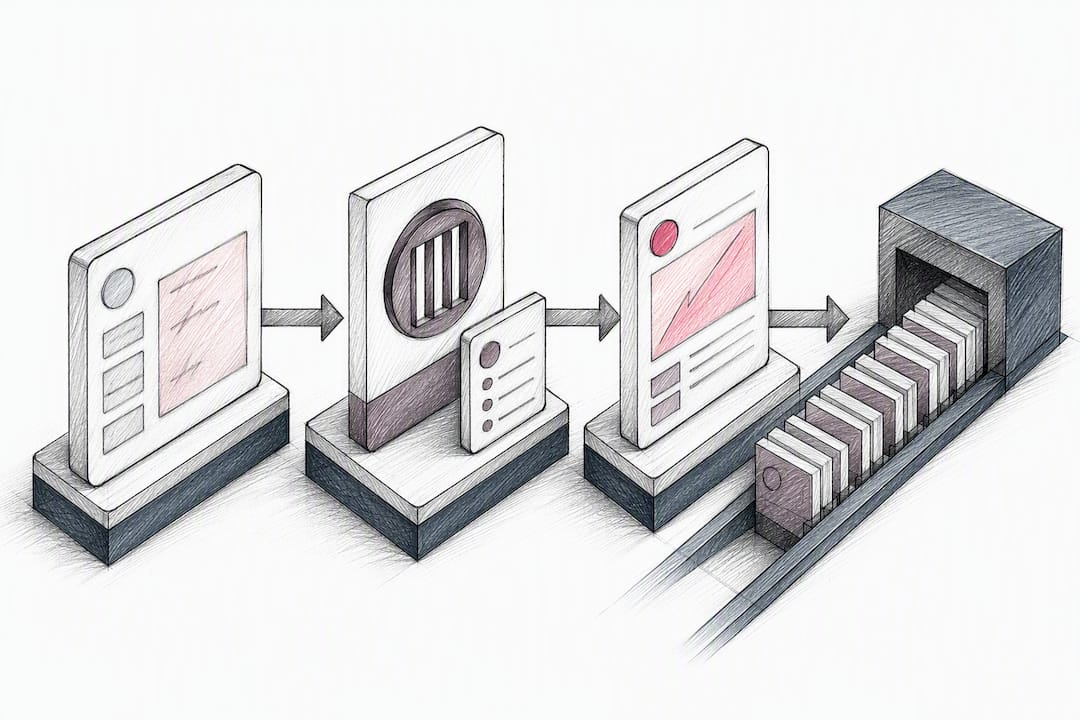
The most common failure I see is unlabeled numbers feeding a decision engine. A budget shift based on an attribution number nobody tagged with its source, method, or confidence level isn't a decision. It's a guess with a dashboard attached. The second failure is missing read-back: teams launch an automated action and never verify it actually happened as intended. The third is a weak approval gate, letting an agent execute instead of propose.
Start narrow. Pick two or three high-impact use cases, templatize them fully, and resist the urge to automate everything at once. Martech stacks are already getting messier by accumulating point solutions faster than teams can govern them; adding agents to an ungoverned stack just multiplies that risk.
— Gabriele Franco
A Managed Path to This Stack: Cassandra
Building the five-layer stack described above from scratch, and keeping the harness, the read-back checks, and the approval gates working as your ad accounts multiply, is a real engineering commitment most marketing teams don't have headcount for. Cassandra is built to close that specific gap: it connects your ad accounts and sales data sources, builds your marketing brain, and then decides budgets, launches campaigns, and produces creative on its own, running every day without the limits of a human team's working hours.
What sets Cassandra apart from a pile of disconnected point solutions is that it doesn't just act fast. It proves the outcome, combining marketing mix modeling, incrementality testing, and attribution into one verdict per channel, the same read-back discipline this article argues every automated stack needs. Cassandra claims to have influenced a large volume of advertising investment. If your team runs meaningful paid media spend and needs that always-on decisioning without building it in-house, explore the platform or check plan details starting at the Essentials tier to see where your stack fits.
Sources
- Marketing Engineer Tech Stack 2026: The Complete Guide — StriveLabs
- MarTech — The martech categories hit hardest by AI agents
- Google Developers — Server-side tagging (GTM) introduction
FAQ
What Is a Marketing Tech Stack?
A marketing tech stack is the full set of software tools a marketing team uses to run campaigns, manage customer data, and measure results, spanning CRM, advertising platforms, analytics, and automation tools. A marketing engineer stack is a more integrated version of this, built with API connections, a warehouse, and orchestration logic so the tools work as one automated system rather than separate applications.
What Does a Marketing Engineer Do?
A marketing engineer builds and maintains the automated pipelines that connect data sources, run experiments, and turn marketing data into decisions, work that differs from marketing ops, which governs and runs existing platforms rather than building new systems. The role blends SQL, API integration, and measurement literacy with commercial judgment about what a business actually needs automated.
Can You Give an Example of a Marketing Tech Stack?
A typical setup pairs a CRM/CDP like Salesforce or HubSpot with a data warehouse such as Snowflake, connected through an integration layer like Zapier or a custom pipeline, orchestrated by automation rules, and increasingly supplemented by AI agents for tasks like creative generation or bid adjustment. Cassandra applies this same layered logic specifically to paid media, combining data connections with budget decisioning and marketing mix modeling in one system.
What Are the Five Marketing Tools Every Stack Needs?
Every functional marketing engineer stack needs a CRM/CDP for identity, a data warehouse for canonical data, an integration or iPaaS layer for moving data between systems, an orchestration layer for sequencing and approving actions, and an AI agent layer for executing bounded tasks. The five-layer pattern holds regardless of which specific vendor fills each slot.
How Much Does a Managed Measurement Platform Cost?
Cassandra's plans start at Essentials from €3,000 per month, with Complete from €3,750 and Scale from €5,400 per month, each scaling with the number of models, experiments, and integrations included. Enterprise pricing is available on request through the same pricing page.