
Cookieless attribution measures marketing impact using first-party data, server-side events, and modeled or aggregated signals instead of third-party cookies. The recommended stack for 2026 combines server-side tracking, first-party data capture, Consent Mode modeling, and triangulation with marketing mix modeling and incrementality testing. Expect directional, calibrated signals, not the deterministic cross-site tracking cookies once delivered.
TL;DR:
- Without third-party cookies, cross-site identifiers and multi-device stitching become unreliable, increasing reliance on login data and hashed emails for attribution.
- Blocked pixels and browser restrictions can cause 20 to 30 percent of conversion events to go untracked, leading to undercounted metrics before any attribution logic is applied.
- Combining server-side tracking, first-party data capture, consent mode modeling, and identity resolution helps recover a significant portion of lost conversions but requires careful calibration and validation.
- Platform-reported ROAS often overstates true incremental lift, so applying deflation factors based on incrementality tests is essential for accurate budget decisions.
- Building a trustworthy cookieless measurement program involves phased implementation, starting with quick server-side wins, followed by identity resolution, modeling, and ongoing calibration through incrementality testing.
Table of Contents
- What Is Cookieless Attribution, and Why Does It Matter Now?
- What Breaks When You Lose Third-Party Cookies?
- Core Cookieless Methods: Server-Side, First-Party Data, and Identity
- How Accurate Is Cookieless Attribution, Really?
- Implementation Roadmap: From Audit to Calibrated Measurement
- Why Triangulation, Not a Single Model, Is the Real Answer
- Tools, Metrics, and a Cookieless-Readiness Scorecard
- Sequencing, Trade-Offs, and What to Actually Expect
- How Cassandra Fits Your Cookieless Measurement Roadmap
- Sources
- FAQ
What Is Cookieless Attribution, and Why Does It Matter Now?
Cookieless attribution assigns credit for conversions using data a business collects and controls directly, rather than data harvested by third-party cookies planted across the web. The distinction matters because a cookie-based model could follow a user from a publisher's display ad to a retailer's checkout page and log every step in between. A cookieless model can't do that across domains anymore. It has to reconstruct the journey from signals a business owns: server logs, hashed emails, CRM records, and modeled estimates.
The gap opened for structural reasons, not a single policy change. Apple's App Tracking Transparency framework cut third-party tracking sharply on iOS starting in 2021. Safari and Firefox have blocked third-party cookies by default for years. Chrome's Privacy Sandbox initiative, though its cookie deprecation timeline has shifted repeatedly, pushed the entire industry to build alternatives regardless of the final enforcement date. Add state and national privacy laws layered on top of browser restrictions, and the practical result is the same: cross-site identifiers you could rely on in 2019 are gone or unreliable in 2026.
None of these touches first-party cookies or server-side signals within your own domain. A business can still:
- Set a first-party cookie when a visitor lands on its own site and read it back on a later visit.
- Log server-side events tied to a session ID, order ID, or hashed customer email.
- Store UTM parameters at lead creation inside a CRM and reference them months later at close.
- Pass hashed identifiers to ad platforms through server-to-server APIs instead of browser pixels.
The constraint isn't "you can't measure anything." It's "you can't measure the way you used to across other people's domains." That distinction shapes every method covered below.
What Breaks When You Lose Third-Party Cookies?
Legacy multi-touch attribution assumed a set of technical capabilities that third-party cookies quietly provided. Losing them breaks specific, identifiable pieces of the measurement pipeline rather than the whole system at once.
- Cross-site identifier loss. Without a shared third-party cookie, there's no common ID linking a user's visit to a publisher site with their later visit to your checkout page. Each domain sees a fragment, not the full path.
- Unreliable multi-device stitching. A shopper who sees an ad on their phone and converts on a laptop used to get stitched together through shared cookie IDs across ad networks. That stitching now depends on login events or hashed-email matches, which only work when the user is signed in or identifiable on both devices.
- Broken deduplication across platforms. When Meta, Google, and TikTok each claim credit for the same conversion using their own imperfect tracking, and there's no shared identifier to reconcile the claims, reported conversions across platforms can exceed actual orders. This is why summed platform-reported conversions frequently overshoot what your order management system shows.
- Missing events from blocked pixels. Ad blockers, Intelligent Tracking Prevention, and browser-level cookie blocking silently drop pixel fires. Practitioner audits have found that cookie-based measurement can miss 20 to 30 percent of conversion events due to blocked pixels and platform changes, meaning your dashboards may be undercounting real conversions before you even get to attribution logic.
The net effect is a reporting layer that looks confident but is quietly wrong in two directions at once: it overcounts through deduplication failures and undercounts through blocked events. Fixing one without the other leaves you with a different kind of bias, not a solution.
Core Cookieless Methods: Server-Side, First-Party Data, and Identity
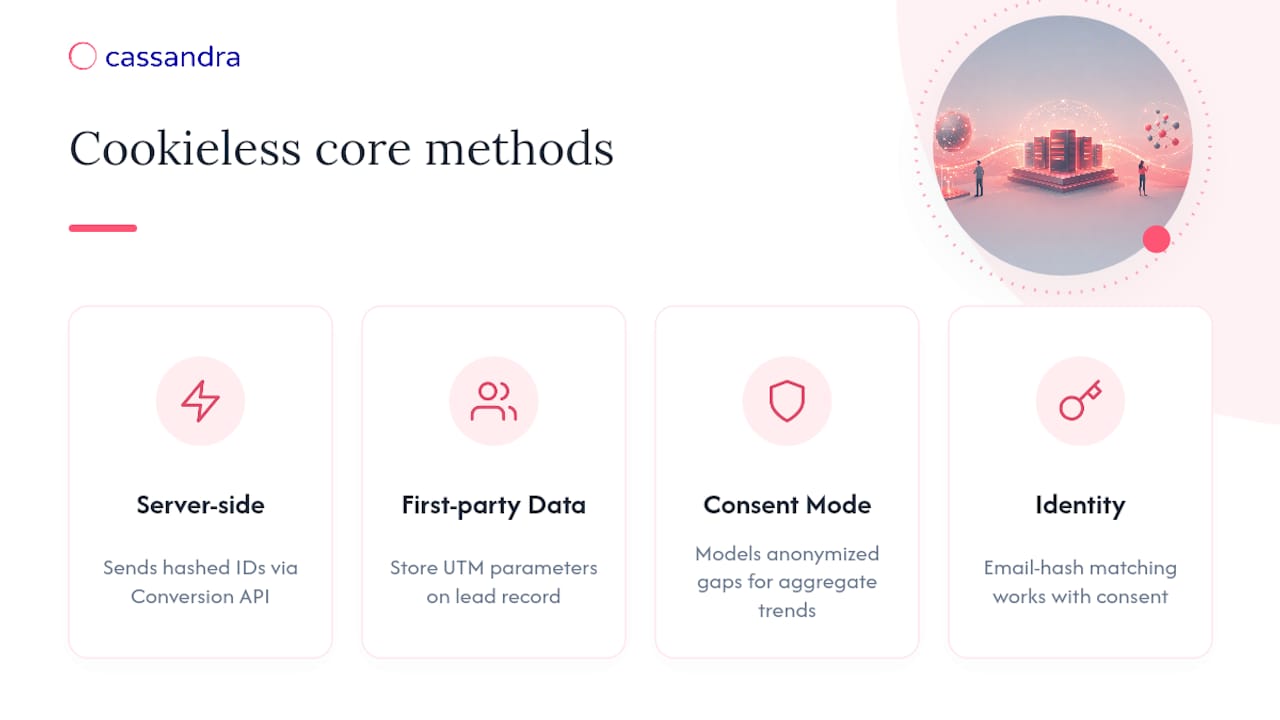
Four categories of technique make up the practical cookieless toolkit. Each one solves a different piece of the puzzle, and none of them solves all of it alone.
Server-side tracking and Conversion APIs. Instead of relying on a browser pixel to fire and survive ad blockers, server-side tracking sends event data directly from your server to the ad platform, typically through a Conversion API like Meta's CAPI or Google's Enhanced Conversions. Because the server sends hashed identifiers (email, phone, or a first-party click ID) rather than depending on browser-side cookies, event match quality improves measurably versus browser pixels alone, and platforms can often reconnect the lost GCLID or click ID to the real transaction.
First-party data capture and CRM linkage. This is the foundation the rest of the stack depends on. Capture UTM parameters the moment a lead is created, whether that's a form fill, a call booking, or an account signup, and store them permanently on that lead record in your CRM. When that lead closes three months later, you still know which campaign originated it. This single practice, more than any tool purchase, determines whether long-sales-cycle businesses can attribute revenue at all.
Consent Mode v2 and modeled fills. Google's Consent Mode allows you to keep collecting anonymized signals from visitors who decline consent, then uses machine learning to model the gaps based on patterns from consented users. This works reasonably well for aggregate trend reporting. It works less well for granular, campaign-level attribution, because the model is filling in behavior it never directly observed. Treat modeled fills as a smoothing layer for totals, not a replacement for consented event data on high-stakes decisions.
Identity resolution and its real limits. Email-hash matching (comparing a hashed customer email against a hashed identifier a platform already holds) is a legitimate, widely used identity resolution method when both parties collected consent properly. Identity graphs that try to probabilistically link devices without explicit consent are a different story. Browser fingerprinting in particular carries real accuracy problems and growing legal exposure, and practitioner reviews caution against relying on it as identity infrastructure. Vendors selling a "universal ID" that promises cookie-era determinism without consent-based collection are usually overselling what the underlying legal and technical environment allows.
Statistic Callout: Server-side implementation and CRM-linked fixes can recover a meaningful share of conversions that browser-pixel tracking alone would miss, largely by reconnecting lost click IDs and reducing false "direct" traffic classification.
Pro Tip: Before you touch attribution modeling, audit your CRM's UTM capture. If a lead loses its source data the moment it moves past your initial form, no attribution model downstream can fix that gap. Fix data capture first; sophisticated modeling on top of broken inputs just produces confident-looking wrong answers.
Realistic accuracy benchmarks matter here. Vendors will quote optimistic match-rate ranges for their Conversion API integration or identity resolution product. Treat those figures as directional starting points, not settled facts, and verify them against your own lift tests before building budget decisions on top of them.
How Accurate Is Cookieless Attribution, Really?
Cookieless multi-touch attribution is directionally useful, not deterministically precise, and treating it as the latter is where most measurement programs go wrong. The core distortions are predictable once you know to look for them.
Platforms are structurally incentivized to over-attribute. Meta, Google, and TikTok each run their own attribution windows and their own claim logic, and each one wants to show marketers a strong return on ad spend. Add multiple platforms claiming the same conversion, and your summed platform dashboards will almost always overstate total attributed revenue relative to what actually shipped.
A few practical rules keep this from misleading your budget decisions:
- Read "match rate" as a confidence signal, not an accuracy guarantee. A high match rate means more events got reconnected to identifiers, not that the resulting attribution split is correct.
- Apply a deflation factor to platform-reported numbers based on what incrementality testing actually shows, rather than trusting self-reported ROAS at face value.
- Present findings to stakeholders as ranges or confidence bands, not single point estimates. "This channel likely drove between 60 and 90 orders last month" is more honest and more useful than a false-precision "84 orders."
- Bias reallocation decisions conservatively when uncertainty is wide. Moving 40% of a channel's budget on a shaky signal is riskier than moving 10% and testing further.
Statistic Callout: A documented rule of thumb for mid-to-large advertisers is one incrementality lift test per major channel per quarter, using the results to build channel-specific deflation factors that reconcile platform-claimed conversions with actual back-end orders.
Without that calibration step, cookieless MTA gives you a plausible-looking number with no way to know how wrong it is.
Implementation Roadmap: From Audit to Calibrated Measurement
A cookieless measurement program is built in layers, not deployed as a single project. Sequencing matters more than any individual tool choice.
- Run the initial audit (week 0). Map every conversion event, check whether your CRM persists UTM parameters at lead creation, and measure your current consent opt-in rate across major markets. This audit tells you exactly how big the gap is before you spend engineering time closing it.
- Deploy quick wins (weeks 0 to 6). Turn on Meta's Conversion API and Google Enhanced Conversions for your highest-spend campaigns first. Set up server-side tagging (via a server-side Google Tag Manager container, for example) for the two or three channels that drive the bulk of your paid budget. This phase typically produces the fastest visible improvement in reported match rate.
- Build mid-term infrastructure (weeks 6 to 24). Establish identity resolution flows using hashed email matching where consent supports it. Export raw event data to a warehouse like BigQuery so your data team, not just ad platforms, owns the source of truth. Implement Consent Mode modeling for aggregate reporting, and start assembling clean historical inputs for marketing mix modeling.
- Run ongoing incrementality tests (continuous, starting around month 3). Once server-side data is stable, launch geo-lift or holdout tests on your largest channels, one per quarter at minimum. Use the results to calibrate both your MTA outputs and your MMM. This is the step most teams skip, and it's the step that turns "we think this channel works" into "we tested it and here's the actual lift."
Pro Tip: Assign clear ownership before you start: engineering owns server-side tagging and CRM integration, analytics owns MMM inputs and lift test design, and marketing owns interpreting results into budget decisions. Programs stall when one team is expected to own all three.
Data governance runs alongside every phase, not after it. Document consent capture logic, keep a record of which hashed fields feed which platform API, and review your privacy posture whenever a state or national law changes. Cassandra's guide to real-time attribution covers the instrumentation details for teams building this out for the first time, and analytics infrastructure investment tends to pay back in measurable ROI improvement once the foundational data capture is solid.
Why Triangulation, Not a Single Model, Is the Real Answer
No single method restores what third-party cookies used to provide, which is precisely why triangulating server-side MTA, marketing mix modeling, and incrementality testing has become the standard practice among measurement practitioners in 2026. Each method compensates for a different weakness in the others.
Server-side MTA gives you fast, granular, day-to-day operational signal, useful for tactical decisions like which ad set to pause this week. MMM gives you a top-down view of channel effectiveness that doesn't depend on individual user identifiers at all, useful for quarterly budget planning. Incrementality testing gives you causal ground truth, the actual lift a channel produces when you turn it off or on in a controlled geography, useful for calibrating the other two.
The calibration loop works like this: run a geo-lift test on a channel, compare the measured lift to what MTA and MMM predicted for that same channel and period, and use the gap to generate a correction factor you apply going forward.
- A holdout test on paid search might show real incremental lift close to what MTA reported, meaning MTA is trustworthy for that channel.
- A geo-lift test on a branded display campaign might reveal the platform was claiming credit for conversions that would have happened anyway, meaning MTA for that channel needs a significant deflation factor.
- Running this consistently across a quarter turns triangulation from a one-time audit into an ongoing operating rhythm.
Anonymized results from incrementality testing programs regularly surface cases where a channel reporting strong platform-attributed ROAS shows a substantially smaller true incremental lift once a holdout test isolates its actual causal effect, correcting a budget allocation that would otherwise have overfunded a channel riding on baseline demand.
A comprehensive approach centers on this exact loop: measurement validation to check whether existing MTA and MMM outputs are internally consistent, instant incrementality testing to generate calibration points without waiting weeks for a traditional geo-lift study, and MMM integration that ingests those calibration results directly rather than treating incrementality as a separate, disconnected workstream. Cassandra's guide on triangulating MTA, MMM, and incrementality testing walks through the mechanics of building that loop for your own stack.
Tools, Metrics, and a Cookieless-Readiness Scorecard
Building a cookieless measurement stack requires specific infrastructure, not just a strategy document. The essential tool categories are a server-side tagging framework (server-side Google Tag Manager or an equivalent), Conversion API connections for each major ad platform, a data warehouse like BigQuery to own your raw event history, and an experimentation platform capable of running geo-lift or holdout incrementality tests.
Five metrics tell you whether the stack is actually working:
- Event match rate, the share of conversions successfully matched to a known identifier after hashing and server-side transmission.
- Consent rate, the share of visitors granting tracking consent, which directly caps how much deterministic data you can collect.
- Platform deflation factor, the correction ratio between platform-claimed conversions and incrementality-confirmed lift.
- Model confidence intervals, the range around MMM and MTA outputs rather than a single misleadingly precise number.
- Test lift, the measured incremental effect from your most recent geo-lift or holdout experiment per channel.
| Readiness factor | Minimum bar to start | Why it matters |
|---|---|---|
| Monthly conversion volume | one per major channel | Below this, incrementality tests and MTA both lack enough signal to be statistically meaningful |
| Engineering capacity | At least part-time support for 1 to 2 quarters | Server-side tagging and CRM integration are engineering-dependent, not marketing-only tasks |
| Consent opt-in rate | Tracked and known, even if low | You need a baseline to know how much modeling is compensating for versus real consented data |
| Data governance | Documented consent and hashing policy | Regulatory exposure grows fast without a clear record of what's collected and how it's used |
Teams that fail this scorecard on conversion volume specifically should lean harder on MMM and incrementality testing, since both work at the aggregate level and don't require the same per-user data density that MTA does.
Sequencing, Trade-Offs, and What to Actually Expect
Prioritize server-side wins first because they're fast, engineering-bounded, and immediately visible in your platform dashboards. Full triangulation with MMM and incrementality testing takes longer to stand up and depends on data infrastructure you may not have yet, so plan for it as the second phase, not a parallel track competing for the same sprint.
Sequence the work with engineering early and analytics second: get server-side events and CRM UTM persistence solid before asking your analytics team to build models on top of them. At three months, expect improved match rates and cleaner CRM data. At six months, expect your first calibrated incrementality results. At twelve months, expect a genuinely trustworthy triangulated view, one that tells you not just what happened, but how confident you should be in it.
— Gabriele Franco
How Cassandra Fits Your Cookieless Measurement Roadmap
Every phase of this roadmap, server-side validation, incrementality calibration, and MMM integration, maps directly to what Cassandra's platform is built to do. Instead of choosing between a fast operational MTA view and a slower, more rigorous MMM and incrementality program, Cassandra runs measurement validation and instant incrementality testing side by side, so calibration happens continuously rather than as a quarterly scramble.

If your team is still relying on platform-reported ROAS without a lift test to check it against, that's the exact gap incrementality testing closes. Cassandra's geo-lift incrementality testing platform generates calibration points fast enough to feed your MMM on an ongoing basis rather than once a year, and the marketing mix modeling software ingests those results directly instead of treating them as a separate report to reconcile manually. Explore Cassandra's measurement use cases to see how brands across ecommerce, fintech, and nonprofit sectors have applied this stack, and request a readiness audit to find out exactly where your current attribution setup needs calibration.
Sources
For deeper technical detail, review the Attribution Reporting API documentation on Privacy Sandbox primitives, the 2026 cookieless attribution overview on triangulation practice, and Cassandra's multi-touch attribution guide for model selection details.
FAQ
What is cookieless tracking?
Cookieless tracking measures user behavior and conversions using first-party data, server-side events, and hashed identifiers instead of third-party cookies, which most major browsers now block or restrict by default.
What does cookie consent mean?
Cookie consent means a website visitor explicitly agrees to allow tracking cookies before they're set, a requirement under privacy laws like GDPR that directly shapes how much deterministic data a cookieless attribution model can collect versus how much it must model.
How do I get rid of cookie consent banners?
You can't legally remove consent banners where regulations require them, but you can reduce their measurement impact by strengthening server-side tracking and first-party data capture so your attribution doesn't depend on every visitor granting cookie consent.
What happens if a visitor opts out of cookies?
When a visitor opts out, third-party tracking cookies aren't set for that session, so platforms rely on Consent Mode modeling or aggregated reporting estimating that visitor's behavior instead of tracking it directly.
How accurate is cookieless attribution compared to cookie-based models?
Cookieless attribution is directional rather than deterministic; server-side tracking and CRM linkage recover a meaningful share of previously lost conversion events, but results still need calibration through incrementality testing to correct for platform over-attribution.