
Bayesian marketing mix modeling estimates each channel's contribution to sales as a full probability distribution rather than a single number, letting teams see not just what a channel likely did, but how confident they should be in that estimate. That distinction drives the primary benefit: budget decisions built on credible intervals instead of point estimates. The framework rests on three building blocks readers will see throughout this piece: adstock for carryover effects, saturation curves for diminishing returns, and priors that inject domain knowledge into the math.
TL;DR:
- Bayesian MMM provides a full probability distribution for each channel's impact, enabling more credible and risk-aware budget decisions.
- Priors from lift tests, experiments, and domain knowledge help anchor estimates for new or sparse channels and hierarchical data structures.
- Proper diagnostics such as R-hat, effective sample size, and posterior predictive checks are essential to trust the model’s calibration before acting on its outputs.
- Validating Bayesian MMM against experimental results and sensitivity analyses ensures the model’s causal and predictive accuracy, preventing overreliance on point estimates.
- Platforms like Cassandra integrate Bayesian MMM with real-time incrementality testing, making probabilistic marketing measurement accessible without extensive in-house modeling efforts.
Table of Contents
- Why Bayesian Marketing Mix Modeling Beats Frequentist Regression for Budget Calls
- Adstock, Saturation, Baseline, and Priors: The Building Blocks
- Building a Bayesian MMM: Data, Specification, and Compute
- How to Validate a Bayesian MMM Before You Trust It
- From Posterior to Decision: Budget Optimization and Talking to the CFO
- How Cassandra Puts Bayesian MMM to Work
- What Most Teams Get Wrong About Bayesian MMM
- Put Bayesian MMM to Work Without Building It From Scratch
- Sources
- FAQ
Why Bayesian Marketing Mix Modeling Beats Frequentist Regression for Budget Calls
Traditional regression-based MMM gives you one number per channel and a p-value that either clears an arbitrary bar or doesn't. Bayesian marketing mix modeling gives you a posterior distribution instead. That distribution tells you not just the most probable return on a channel, but the full range of plausible returns given your data, and the shape of that range matters enormously when you're about to move seven figures in ad spend.
Bayesian methods make this possible because they add probabilistic uncertainty estimates to the parameters governing your model, rather than collapsing everything into a single coefficient and a confidence band tacked on as an afterthought, as PyMC Labs explains. When you allocate budget off a posterior, you can state a probability that shifting budget from one channel to another improves incremental revenue, rather than a binary "search wins."
A few conditions make Bayesian approaches particularly worth the added complexity:
- Sparse or new channels. When a channel has twelve weeks of spend data instead of two years, a frequentist model will happily overfit to noise. A Bayesian prior anchors the estimate to a plausible range until the data earns the right to move it.
- Segmented or hierarchical data. Brands running MMM across regions, product lines, or business units benefit from hierarchical pooling, where each segment borrows statistical strength from the others instead of being modeled in total isolation. This technique, identified by Rossi and Allenby, is one of the strongest cases for Bayesian marketing analytics.
- Blending experiments with historical data. Priors let you formally encode what a geo-experiment or lift test already told you, so the model doesn't have to relearn it from scratch.
- High-stakes reallocation decisions. If a wrong call costs millions, a distribution beats a point estimate every time.
Statistical reality check: a model that reports "$1.40 return per dollar on paid social" without a credible interval is answering a different question than the one you're asking.
None of this means frequentist MMM is obsolete. For a stable, data-rich channel with years of consistent spend, a simpler regression can be perfectly adequate, and faster to run. Bayesian marketing mix modeling earns its complexity when uncertainty itself is decision-relevant, which for most marketing budgets, it is.
Adstock, Saturation, Baseline, and Priors: The Building Blocks
Two non-linear functions carry most of the explanatory weight in any marketing mix model: the adstock function, which captures how an impression's effect persists after the ad stops running, and the saturation function, which captures how each additional dollar returns less than the one before it. Getting these two functions right is, according to PyMC Labs, central to model accuracy.
Adstock models carryover. A television ad someone saw on Tuesday still influences a purchase decision on Friday, just less than it would have on Wednesday. The most common parameterization is geometric decay, where each week's effect is a fraction (the decay rate) of the prior week's remaining effect. Some teams use a Weibull adstock instead, which allows the decay curve to rise before it falls, better matching channels like TV or out-of-home where recognition builds before it fades. The decay parameter itself is rarely known with precision, which is exactly why it gets a prior rather than a fixed value.
Saturation models diminishing returns. Spend a little on paid search and you capture high-intent clicks cheaply; spend a lot more and you're bidding on marginal keywords that convert less often. The Hill function and logistic curves are the two most widely used shapes, each defined by parameters controlling the inflection point and the steepness of the curve. Choosing between them is less about theoretical purity and more about which shape your channel's historical spend and response actually resembles.
Baseline and interactions round out the specification. Every model needs a baseline term capturing sales that would happen with zero marketing, plus seasonality controls, pricing, distribution, and macroeconomic variables. Skip these and your model will happily attribute a Black Friday spike to your email campaign.
Where do the priors themselves come from? Three sources dominate in practice:
- Lift tests and geo-experiments, which provide a direct, causal read on a channel's effect that can be encoded as an informative prior.
- Expert elicitation, where a media buyer's experience ("TV response tends to peak around week three") becomes a soft constraint rather than a hard rule.
- Domain heuristics and industry benchmarks, useful as a starting point when neither of the above is available yet.
Pro Tip: Don't default every parameter to a vague, uninformative prior just because you can. A weakly informative prior on saturation, built from even a rough sense of channel-level spend history, will save your model from wandering into implausible territory during early sampling.
Building a Bayesian MMM: Data, Specification, and Compute
Getting from raw spend data to a defensible posterior takes a defined sequence, and skipping steps almost always shows up later as convergence problems or nonsensical budget recommendations.
- Assemble weekly (or daily) data by channel. You need to spend, impressions or clicks where available, and the outcome variable (revenue, conversions, or orders), typically at a granularity fine enough to capture adstock decay but coarse enough to smooth out noise. Missing weeks, promotional overlaps, and channel definition changes all need cleanup before modeling starts.
- Specify the likelihood. Most marketing outcome data is strictly positive, right-skewed, and heteroscedastic, which makes a lognormal or gamma likelihood a more honest choice than the Gaussian error structure a lot of off-the-shelf regression tools default to. Getting the error structure wrong understates uncertainty in exactly the ranges that matter most for budget decisions.
- Choose an inference method. The No U-Turn Sampler (NUTS) is the standard for final model runs because it produces properly calibrated posteriors, but it's computationally heavier. Variational inference trades some calibration accuracy for speed, making it useful for rapid iteration while you're still testing model structure.
- Select your tooling. PyMC-Marketing has become a default choice in the open-source space, offering built-in adstock transformations, saturation effects, custom priors, and diagnostics without requiring the team to hand-build every component. GPU backends and multiple sampler options now make it realistic to run full Bayesian MMM in production rather than treating it as an academic exercise, a shift the tooling has undergone in a few years.
Compute reality check: a NUTS run across a dozen channels with weekly data over three years typically takes minutes to low tens of minutes on modern hardware, not the hours-long ordeal Bayesian inference implied a decade ago. That drop in compute cost is a big part of why Bayesian MMM has moved from research papers into quarterly planning cycles.
If your team is evaluating platforms rather than building from scratch, the selection criteria differ depending on whether you need a flexible research environment or a production-grade media mix modeling tool with built-in governance.
How to Validate a Bayesian MMM Before You Trust It
A posterior distribution is only as trustworthy as the sampling process that produced it, and skipping diagnostics is how teams end up presenting confidently wrong numbers to a CFO.
Three checks come first, before anything else gets reviewed:
- R-hat close to 1.0 across all parameters, ideally under 1.01, indicating the multiple sampling chains have converged to the same distribution rather than exploring different regions independently.
- Effective sample size (ESS) high enough, generally in the hundreds at minimum, that your posterior isn't secretly built from a handful of correlated draws masquerading as thousands.
- Trace plots that look like healthy, overlapping noise across chains rather than chains that drift apart or get stuck.
Beyond convergence, posterior predictive checks compare simulated data drawn from the fitted model against the actual observed outcome. If the model can't reproduce basic patterns in your own historical sales, no amount of clean MCMC diagnostics saves it. Holdout validation, where you fit on part of the time series and check predictions against the rest, catches overfitting that in-sample checks miss entirely.
Sensitivity analysis matters just as much. Refit the model with meaningfully different priors and alternative functional forms (swap the Hill saturation for logistic, try a different adstock decay structure) and see whether your headline conclusions hold. A recommendation that flips based on a minor prior tweak isn't a recommendation yet.
The strongest validation, though, comes from outside the model entirely. Calibrating MMM output against lift tests and geo-experiments is explicitly discussed as a technique to validate estimates, since PyMC Labs notes that experimental evidence gives you a causal anchor the model itself can't generate alone. This is also where the practical integration of MMM, incrementality testing, and attribution pays off: each method corrects for the other's blind spots.
From Posterior to Decision: Budget Optimization and Talking to the CFO
A posterior distribution isn't a budget recommendation on its own. Turning it into one requires a defined objective and a way to communicate probability to people whose job is not statistics.

Start with the objective. Most teams frame it as maximizing expected incremental revenue (or profit) subject to a total spend constraint, computed by running the optimization across many posterior draws rather than a single point estimate. That gives you a distribution of optimal allocations, not one "correct" answer, which is the entire point.
From there, three steps turn the math into something a marketing organization can act on:
- Run scenario simulations. Ask the model what happens to expected outcomes under a 10% budget cut, a shift toward retail media, or a flat budget with reallocated mix, and report each scenario with its own credible interval rather than a single projected number.
- Apply probability-based decision rules. Instead of "move the budget," frame it as "there's a 78% chance this reallocation improves quarterly revenue by at least 5%." That threshold-based framing, mapping directly onto how risk-adjusted decisions get made in other areas of the business, gives executives a familiar way to weigh a bet against its downside.
- Build visuals that show the range, not just the midpoint. Fan charts and interval bars communicate uncertainty far better than a bar chart with a single height per channel, and they set the right expectation that marketing measurement deals in probabilities, not guarantees.
A few things consistently help this land with nontechnical stakeholders:
- Anchor every recommendation to a dollar range, not just a percentage.
- Show the downside scenario explicitly, not just the upside case.
- Tie the probability threshold to a decision the business already understands, like a hurdle rate.
Analytics-driven decision-making of this kind has been linked to meaningfully stronger marketing ROI than budget decisions made on intuition or last year's plan alone, largely because probabilistic framing forces the conversation toward risk tolerance rather than false certainty.
How Cassandra Puts Bayesian MMM to Work
Cassandra runs Bayesian marketing mix modeling as one layer in a combined measurement workflow, pairing it with instant incrementality testing and measurement validation so posterior estimates get checked against real experimental results rather than trusted in isolation. That combination addresses the core weakness of any standalone MMM: a model can be internally consistent and still be wrong about causality.
Some brands have used this workflow to improve return on ad spend and reduce wasted budget, with results varying by sector and measurement maturity. Deployment can be tailored to different team sizes and needs, from self-serve access for analysts to guided implementation and managed services for larger organizations.
What Most Teams Get Wrong About Bayesian MMM
Before launching a Bayesian MMM, run a real data audit, confirm your priors align with any experiments you've already run, and scope your compute plan before, not after, you discover NUTS sampling on a dozen channels takes longer than expected.
The pitfalls that come up most: treating endogeneity as someone else's problem, letting overly flexible saturation curves fit noise instead of signal, and handing a CFO a point estimate because a credible interval feels harder to defend. It rarely is.
Rely on experiments alone and you lose the full-funnel view; rely on MMM alone and you lose causal grounding. The strongest measurement programs run both, continuously, and let each correct the other.
— Tools
Put Bayesian MMM to Work Without Building It From Scratch
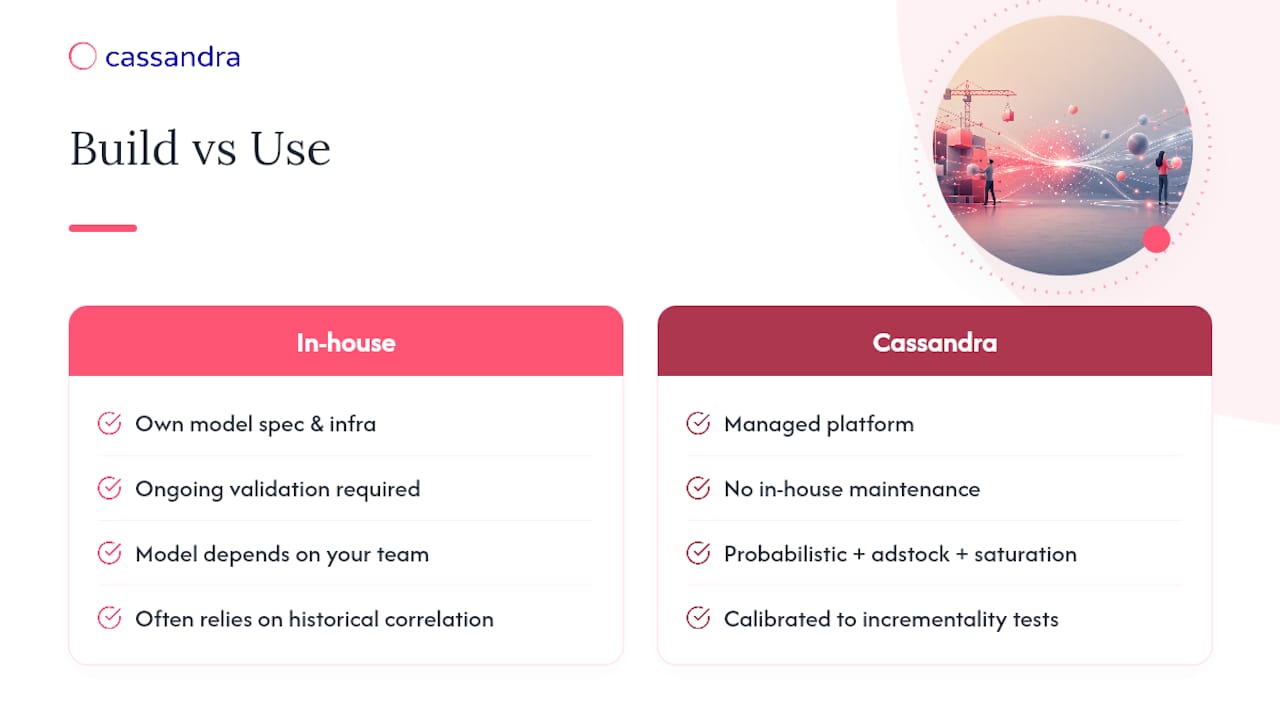
Building a production Bayesian MMM in-house means owning the model specification, the sampling infrastructure, and the ongoing validation work this article just walked through, on top of your actual marketing job. Cassandra gives marketing teams that same probabilistic rigor, adstock and saturation modeling, hierarchical pooling, credible intervals for every channel, without requiring an in-house data science team to maintain it.

What sets Cassandra's approach apart is that the model doesn't run in isolation. Every MMM output gets calibrated against instant incrementality tests run on your own traffic, so the posterior you're handed has already been checked against causal experimental evidence rather than left to stand on historical correlation alone. That closes the exact validation gap this article covered in the diagnostics section.
Explore the marketing mix modeling platform to see how the model specification and budget optimization tools work in practice, or review measurement use cases across sectors including fashion, nonprofit, and travel. If you're ready to see posterior-driven budget recommendations run against your own channel mix, request a walkthrough of the platform directly.
Sources
For deeper grounding, Rossi and Allenby's Bayesian Statistics and Marketing remains a foundational academic reference on hierarchical Bayesian methods in marketing. PyMC-Marketing's documentation covers implementation details for adstock, saturation, and diagnostics. For current research directions, see the agentic Bayesian optimization paper and the Lemonade MMM preprint on arXiv.
- Bayesian Media Mix Modeling for Marketing Optimization
- Bayesian Statistics and Marketing (Rossi & Allenby)
FAQ
What is Bayesian mixture modeling?
Bayesian mixture modeling is a statistical technique that assumes observed data comes from a combination of several underlying probability distributions, with Bayesian methods used to estimate each distribution's parameters and the probability that a given data point belongs to each one. It's a distinct concept from Bayesian marketing mix modeling, though both share the same underlying Bayesian inference machinery.
What is a Bayesian mixed model?
A Bayesian mixed model is a hierarchical model that includes both fixed effects (parameters shared across all units) and random effects (parameters that vary by group, like region or customer segment), estimated using Bayesian inference. This is the same hierarchical pooling structure that makes Bayesian MMM effective for brands with multiple markets or business units.
What is Bayesian modeling?
Bayesian modeling is an approach to statistics that treats unknown parameters as probability distributions rather than fixed values, updating those distributions as new data arrives using Bayes' theorem. In marketing, that means channel effects, adstock decay, and saturation curves all get expressed as ranges of plausible values rather than single numbers.
Are large language models Bayesian?
Most large language models are not inherently Bayesian; they're typically trained through maximum likelihood estimation rather than full Bayesian inference over a prior distribution. Researchers have explored Bayesian interpretations and Bayesian fine-tuning approaches for language models, but that remains a distinct research area from the Bayesian marketing mix modeling techniques covered here.
How is Bayesian MMM different from traditional regression-based MMM?
Traditional MMM produces a single point estimate per channel with a confidence interval added afterward, while Bayesian MMM produces a full posterior distribution for every parameter from the start, incorporating prior knowledge and quantifying uncertainty throughout the modeling process rather than as an afterthought.
Can Bayesian MMM replace incrementality testing entirely?
No. Bayesian MMM works best alongside incrementality testing and geo-experiments, which provide causal, ground-truth signal that calibrates and validates the model's posterior estimates rather than serving as a substitute for them.