
An AI media buyer is a system that automates bid, budget, creative, and measurement decisions across ad platforms, executing changes continuously instead of on a human's weekly review cycle. It fits teams with recurring paid media spend, first-party conversion data, and the discipline to keep a measurement layer underneath it. If that describes your marketing organization, the question is not whether to adopt one, but how to stage the rollout without losing control of your budget.
TL;DR:
- Automated budget shifts should be limited to about 30% of total spend during initial implementation to maintain control and build trust.
- Reliable measurement integration, including incrementality testing and marketing mix modeling, is essential for proving that automated decisions drive real revenue.
- Connecting all data sources, such as CRM and first-party conversions, is crucial for the AI system to optimize towards actual business outcomes rather than proxy signals.
- A fully auditable system with clear logs and reversible actions minimizes risk and supports compliance in automated media buying.
- Phased rollout over four to eight weeks, with a focus on data quality and incremental testing, reduces the risk of losing oversight and budget control.
Table of Contents
- How AI Media Buyers Work: Data, Models, and Execution Loops
- Key Capabilities to Look for in an AI Media Buyer
- Practical Use Cases and the Outcomes You Can Expect
- Phased Implementation: Data Foundation, Pilot, and Scale
- How to Evaluate Solutions and Vendors Scientifically
- Cassandra's Platform Proof Points and Case Study Reference
- Realistic Expectations and Trends for 2026
- Get Started With Measurement-First AI Media Buying
- Sources
- FAQ
How AI Media Buyers Work: Data, Models, and Execution Loops
An AI media buyer runs on three layers that have to work together: data inputs, a decision engine, and an execution layer that actually touches your ad accounts. Skip any one of them and you have a dashboard, not a media buyer.
The data layer pulls from your connected ad platforms (Google, Meta, TikTok, LinkedIn), your CRM, and first-party conversion events like purchases, sign-ups, or qualified leads. Without clean event data flowing back into the system, the model is optimizing toward proxy signals rather than revenue. This is the single most common reason automated buying underperforms: the inputs were never trustworthy in the first place.
The decision engine sits on top of that data and does the actual thinking. Technical explainers describe these systems as continuous optimization loops. They classify signals, evaluate creative and audience performance, and recommend or execute the next action. Predictive models forecast which budget allocation, bid, or creative variant is likely to perform best given recent history, but they are probabilistic, not clairvoyant. A model trained on four weeks of holiday traffic will misfire in a slow February unless it's retrained or bounded by guardrails.
The execution layer is where the risk actually lives. Some platforms push changes straight to the ad account through API calls; others route recommendations through a human-in-the-loop approval gate before anything goes live. Protocol documentation for programmatic booking shows why auditability matters here: every automated action needs a record, a timestamp, and ideally a reversal path, because an unsupervised budget shift at 2 a.m. can burn through a week's spend before anyone notices.
Key elements of the execution loop include:
- Signal ingestion: pulling platform-reported and first-party conversion data on a rolling basis, often hourly for spend decisions and daily for creative performance.
- Model scoring: ranking budget allocations, bids, or creative combinations by predicted return.
- Guardrails: caps on daily spend shifts, blocked audience segments, or mandatory human sign-off above a spend threshold.
- Execution and logging: the actual API call to the ad platform, paired with an audit trail of what changed and why.
- Feedback: results flow back into the model, which adjusts its next round of scoring.
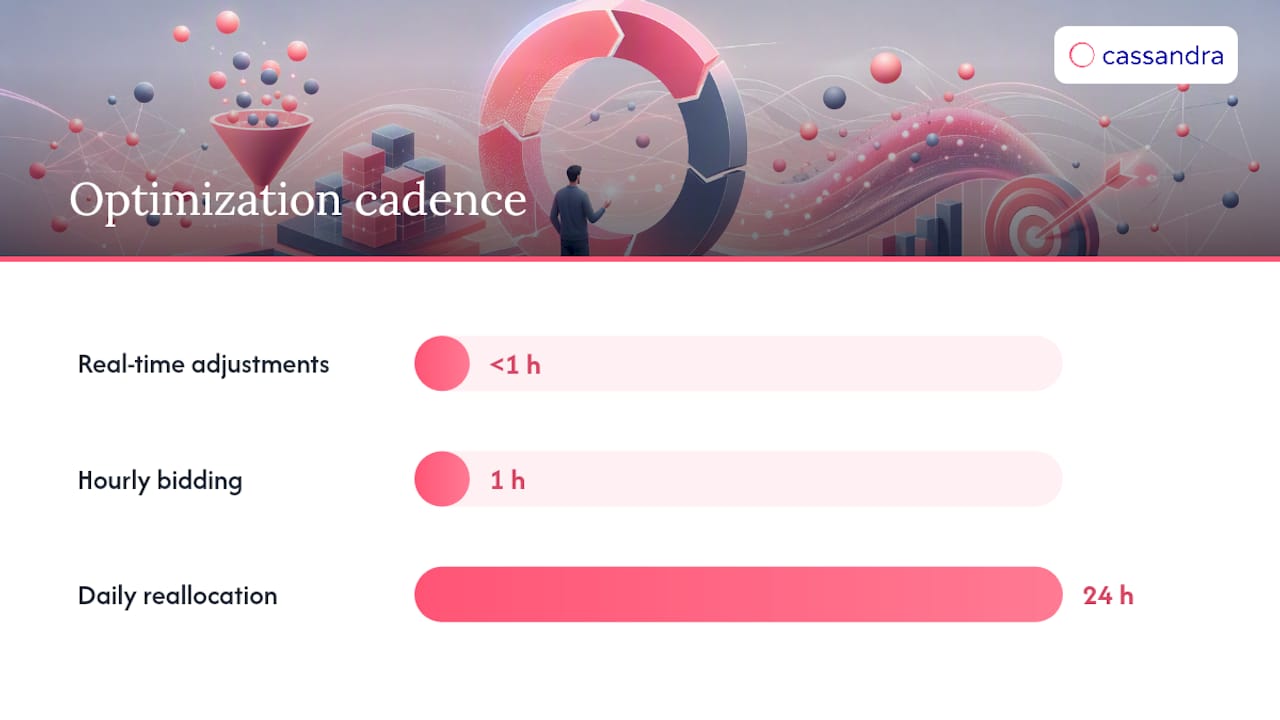
Optimization cadence varies by platform maturity. Search and social bidding often runs on hourly or even real-time adjustment cycles, while budget reallocation across channels tends to run daily, giving enough data to avoid chasing noise. IAB Tech Lab's Buyer Agent specification frames the next step in this evolution: buyer agents that discover seller inventory, negotiate pricing, and book deals programmatically through OpenDirect 2.1, using identity-based tiered pricing rather than static rate cards.
Key Capabilities to Look for in an AI Media Buyer
Not every platform marketed as an "AI media buyer" covers the same ground. The category splits into distinct capability sets, and the gaps between them determine how much control you retain and how defensible the results are.
- Campaign planning and structure generation: building out campaign, ad set, and audience architecture based on historical performance patterns rather than a blank template.
- Automated budget allocation and bid optimization: shifting spend across channels and campaigns within guardrails you define, not open-ended discretion.
- Creative generation and testing: producing ad variants and running multivariate experiments to identify which combinations of copy, imagery, and format perform best.
- Inventory discovery and programmatic direct negotiation: relevant mainly for larger buyers working with premium publishers, where agent-to-agent negotiation through standards like OpenDirect is starting to replace manual RFPs.
- Measurement integration: attribution, incrementality testing, and marketing mix modeling feeding back into the optimization engine rather than sitting in a separate reporting tool.
- Governance: audit logs, naming conventions, and approval workflows that let a human override or roll back any automated action.
The governance layer is the one buyers underweight most often. A system that can spend your budget autonomously but can't show you why it made a specific call, or can't be paused mid-campaign, is a liability dressed up as convenience.
Pro Tip: Ask any vendor for a live example of their audit log before you sign anything. If they can't show you a timestamped record of a specific budget change and the reasoning behind it, assume that capability doesn't exist yet.
Practical Use Cases and the Outcomes You Can Expect
AI media buying fits some organizational profiles far better than others. The clearest fit is the lean marketing team managing multiple channels without the headcount to check bids and budgets daily.
- Lean teams running cross-channel campaigns. A team of two or three managing Google, Meta, and TikTok simultaneously benefits most from continuous optimization, since manual monitoring across three platforms in real time simply isn't feasible at that staffing level.
- Always-on optimization for high-frequency spend. Brands running promotions or flash sales gain from systems that can react to performance shifts within hours rather than waiting for the next weekly review.
- Creative scaling. Teams that need dozens of ad variants tested per week, rather than the two or three a human designer can turn around, see the clearest efficiency gain from automated creative generation. Third-party analysis of AI adoption at agencies points to meaningful productivity gains when creative and account work get automated, freeing strategists for higher-value analysis.
- Agencies managing many client accounts. Standardizing optimization logic across accounts reduces the variance between a junior buyer's decisions and a senior one's.
Outcome expectations should stay conservative in the first quarter. Modest ROAS and CAC improvements are realistic once the model has enough data to act on, typically after four to eight weeks of clean signal. Readiness matters more than budget size: a brand spending $50,000 a month with reliable first-party conversion tracking will get more from automation than one spending $500,000 a month with fragmented, delayed attribution data.
Phased Implementation: Data Foundation, Pilot, and Scale
Rolling out an AI media buyer in one step, flipping every campaign to full autonomy on day one, is how teams lose control of budget and trust in the system simultaneously. Industry implementation guides consistently recommend a phased approach instead.
- Data foundation (1 to 6 weeks). Connect ad platforms, CRM, and first-party event tracking. Audit for gaps: missing conversion events, delayed data feeds, or inconsistent UTM tagging will all quietly sabotage the model later.
- Pilot with guardrails (4 to 8 weeks). Run the system on a limited budget slice, with clear approval gates before any large budget shift executes. Design this phase as a genuine experiment, not a soft launch, with a defined control group where possible.
- Scale and continuous validation. Expand the automated share of budget only after the pilot shows results that hold up under incrementality testing, not just platform-reported conversions.
What to track differs by phase:
- During the data foundation phase, watch for data completeness and latency, not performance metrics yet.
- During the pilot, track primary KPIs (CAC, ROAS) alongside diagnostic metrics like the frequency of guardrail triggers and how often human review overrides a recommended action.
- During scale, run periodic incrementality or geo-lift tests to confirm the automated decisions are still causing the results, not just correlating with them.
A media mix modeling framework can serve as the backstop across all three phases, since it validates channel-level contribution independent of what any single platform reports about itself.
How to Evaluate Solutions and Vendors Scientifically
Vendor demos are built to impress, not to reveal limitations. The questions that actually separate a durable AI media buyer from a dashboard with a chatbot bolted on tend to focus on data access, measurement, and reversibility.
- Integration breadth: Does the platform connect to your CRM and POS system, or only to ad platform APIs? Budget decisions built on platform-reported conversions alone tend to overstate performance.
- Measurement closure: Does the system support incrementality testing or marketing mix modeling, or does it rely entirely on last-click and platform attribution? Measurement-first guidance treats this as non-optional: without it, you cannot prove automated decisions caused a revenue change rather than just correlating with one.
- Control and transparency: Can every automated action be reversed? Is there an audit log a non-technical stakeholder can read?
- Creative pipeline: Does the platform generate and test creative variants natively, or does it only optimize spend against creative you upload manually?
- Commercial model: Does pricing scale with ad spend, number of integrations, or seats, and does the contract lock you into a minimum term before results are provable?
Ask vendors directly: "Show me an incrementality test you ran for a client in our category." Ask internal stakeholders: "Who has authority to pause the system, and how fast can they do it?" A vendor that can't answer the first question, or a team that can't answer the second, is a red flag serious enough to pause the pilot until it's resolved.
Cassandra's Platform Proof Points and Case Study Reference
Cassandra operates as a measurement-first AI media buyer: it connects ad accounts and sales data sources, builds a brand-specific marketing model, then decides budgets, launches campaigns, and produces creative, running continuously without the constraints of a fixed work schedule.
- Scale of influence: The platform has influenced a significant amount of advertising investment to date, spanning ecommerce, B2B, fintech, and retail brands with meaningful paid media budgets.
- Case study evidence: Footwear brand Velasca rebuilt its entire media plan after using measurement to reveal the true ROI of offline channels that platform-reported attribution had been undervaluing.
- Measurement integration: rather than treating attribution as a separate reporting layer, this platform folds marketing mix modeling, incrementality testing, and attribution into a single verdict per channel, which then feeds directly into the next budget decision.
That closed loop, decide, measure, learn, decide again, is what separates an automated spend tool from a system that can actually defend its own results to a CFO.
Realistic Expectations and Trends for 2026
The IAB Tech Lab's buyer-agent framing points toward agent-to-agent negotiation becoming standard for programmatic direct deals, using protocols for discovery and identity-based pricing. That shifts human effort away from manual RFPs and toward setting the rules agents negotiate within.
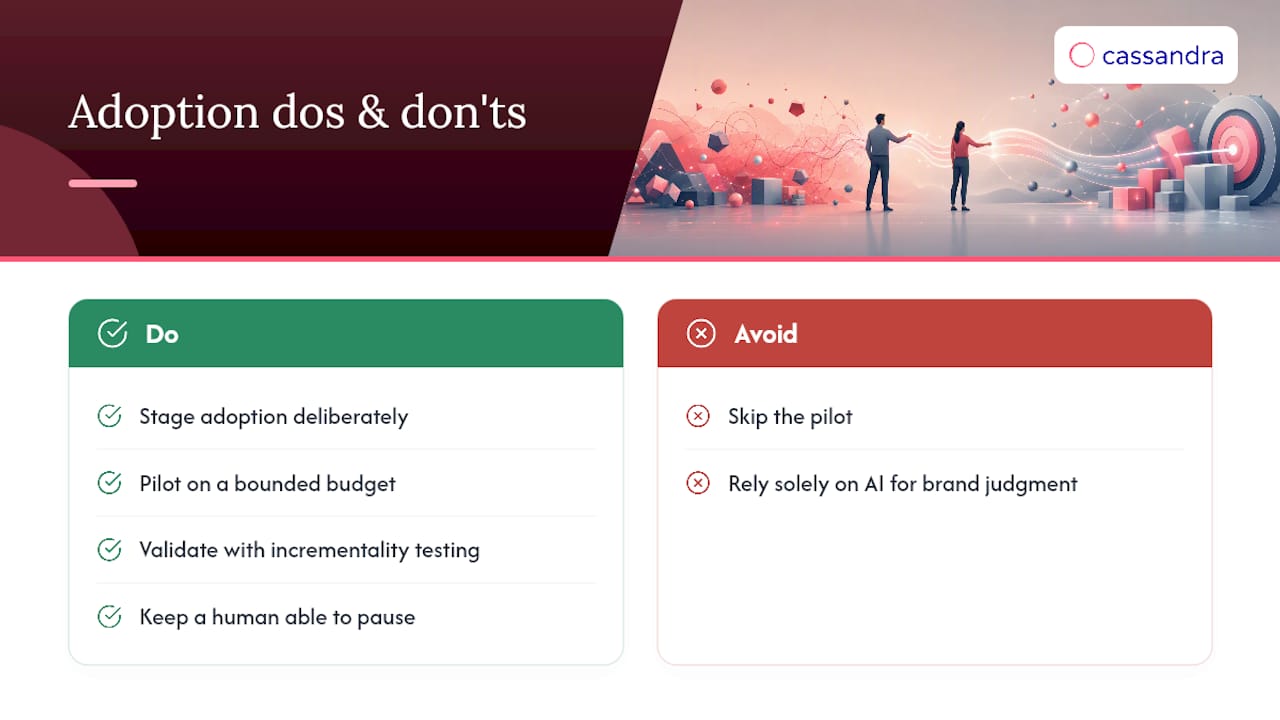
AI handles pattern recognition and execution speed better than any human team can. It does not yet handle judgment calls about brand risk, category nuance, or why a metric moved for reasons outside the data it can see. Stage adoption deliberately: pilot on a bounded budget, validate with incrementality testing before scaling, and keep a human able to pause the system at any point. The organizations that get burned by agentic buying are the ones that skip the pilot, not the ones that adopt the technology.
— Gabriele Franco
Get Started With Measurement-First AI Media Buying
Cassandra is built for teams who want automation that can prove its own results, not just report them. Instead of handing budget decisions to a system that optimizes against platform-reported conversions alone, Cassandra combines marketing mix modeling, incrementality testing, and attribution into one verdict per channel, then uses that verdict to decide where the next dollar goes.
If you're evaluating whether your data and processes are ready for automated media buying, start with the platform overview to see how the measurement layer connects to daily budget decisions, or review Essentials, Complete, and Scale pricing to find the tier that matches your spend level. Teams focused specifically on proving incrementality before scaling automation can go straight to the incrementality testing product page. Request a demo to see how the loop runs on your own ad accounts before committing budget to it.
Sources
- IAB Tech Lab — Buyer Agent
- What Is an AI Media Buyer? Definition & Guide 2026
- How AI agents work in media buying and programmatic
- Docs
FAQ
What Is the 30% Rule for AI in Media Buying?
If you've heard the phrase, it likely refers informally to capping automated budget shifts or the autonomous share of total spend at a modest limit while a system proves itself, a guardrail practice rather than a fixed industry standard.
How Do Marketing Teams Make Money With AI Media Buying?
Teams see returns primarily through faster optimization cycles and reduced wasted spend, since the system can reallocate budget toward better-performing campaigns hourly instead of weekly. The gains only hold up when incrementality testing or marketing mix modeling confirms the automated decisions are driving real revenue, not just shuffling credit between channels.
How Do You Get Hired as a Media Buyer in an AI-Driven Market?
Media buying roles are shifting from manual bid management toward overseeing automated systems, setting guardrails, and interpreting measurement output. Candidates who understand incrementality testing, marketing mix modeling, and how to audit an AI system's decisions have an advantage over those with only platform-certification experience.
Is Being a Media Buyer a Stressful Job?
Media buying has historically ranked as a high-pressure role due to constant account monitoring, tight budget accountability, and fast-moving platform changes. Automation is shifting some of that pressure toward oversight and strategy rather than eliminating it, since someone still has to set the guardrails and interpret why a model made a given call.
What Makes Cassandra Different From a Standard AI Media Buyer?
Cassandra closes the loop between automated decisions and proof of revenue impact, combining marketing mix modeling, incrementality testing, and attribution into one verdict per channel rather than relying on platform-reported conversions alone. Current pricing for the Essentials, Complete, and Scale plans is listed on Cassandra's pricing page.