

Aggregated event measurement is a privacy-safe, platform-level approach that produces finance-grade event aggregates and causal validation inputs for enterprise measurement programs. Cassandra builds this layer into a broader triangulation stack, and this guide shows analytics and media teams how to define it, test it, and operationalize it without wasting a quarter of budget finding out the hard way.
TL;DR:
- Aggregated event measurement reduces reliance on platform-reported ROAS by producing validated, cross-channel, privacy-safe data suitable for marketing mix modeling and decision-making.
- Designing effective incrementality tests requires aligning event definitions, choosing appropriate holdout methods, and ensuring sufficient test duration and statistical power within API batching constraints.
- Accurate revenue modeling depends on reconciling online events with offline and CRM data, especially for long-sales cycles, to reflect true business outcomes.
- Compliance with GDPR and CCPA is strengthened by batch processing and cohort reporting, but lawful data collection remains essential to avoid legal exposure.
- Implementing aggregated measurement effectively demands cross-functional ownership, incremental testing approach, and tools like Cassandra to automate validation and integrate insights seamlessly.
Table of Contents
- What Is Aggregated Event Measurement?
- Why Aggregated Measurement Matters Now
- Where It Fits in the Measurement Stack
- How Do You Design an Incrementality Test?
- What Does the Implementation Checklist Look Like?
- How Do You Turn Lift Into a Budget Decision?
- How Do You Integrate CRM and Offline Conversion Data?
- Does Aggregated Measurement Meet GDPR and CCPA Standards?
- How Should Measurement Leaders Operationalize This?
- How Cassandra Helps You Operationalize This
- Sources
What Is Aggregated Event Measurement?
Aggregated event measurement is a privacy-safe method for combining and modeling conversion events across channels into reportable, decision-ready aggregates, rather than tracking individual users. It exists because user-level tracking has become both legally risky and technically unreliable, so enterprise teams need a way to answer "did this campaign work?" using data that never resolves to a single person.
Four building blocks make it work. Aggregated ingestion collects event data (purchases, sign-ups, leads) from ad platforms, server-side pixels, and CRM systems without stitching individual identities across sources. Trusted aggregation batches and sums those events into cohort-level totals, often under enforced minimum thresholds. A modeling and attribution layer then reconciles those aggregates against known spend and business outcomes to estimate contribution by channel. Finally, privacy constraints, batching windows, noise injection, and reporting delays, shape what level of precision is even possible.

This is worth separating clearly from platform-specific protocols like a single ad network's own event-measurement rules. Those are vendor-side technical implementations for one walled garden. Aggregated event measurement, as Cassandra applies it, is the cross-channel, platform-level layer that sits above those protocols and turns scattered aggregate signals into one coherent reporting and causal-validation system.
Why Aggregated Measurement Matters Now
Signal loss changed the math for every media team. App Tracking Transparency, cookie deprecation, and platform-level restrictions have each cut into user-level visibility, and platforms have compensated by leaning harder on their own modeled and self-attributed conversion counts. The result is more inflated, less trustworthy platform-reported ROAS across the board.
At the same time, finance and retail media partners are asking for real proof, not attribution dashboards. Over half of US brand and agency marketers, 52% according to EMARKETER and TransUnion, now run incrementality tests specifically because platform numbers alone no longer satisfy CFOs asking whether spend created net-new revenue or simply got credit for it.
Aggregated event measurement addresses both pressures at once:
- It reduces reliance on any single platform's self-reported attribution, since aggregates get validated against independent experiments.
- It produces inputs clean enough to feed directly into marketing mix models without manual reconciliation.
- It gives media planners a defensible number to bring into budget conversations instead of a platform-inflated one.
Where It Fits in the Measurement Stack
No single method answers every question a Head of Marketing gets asked, which is why triangulation, not method selection, is the real skill. Marketing mix modeling (MMM) sets the strategic envelope: how much to spend, by channel, over a quarter or a year. Multi-touch attribution (MTA) steers day-to-day: which campaigns to pause, which creative to scale this week. Incrementality testing acts as the causal referee, the only method that tells you whether the spend actually caused the outcome or merely coincided with it.
Aggregated event measurement supplies the reconciled, privacy-safe inputs that keep all three methods honest. Rather than treating them as competing dashboards, mature teams triangulate MMM, MTA, and incrementality into a single decisioning workflow: run an incrementality test, use its lift factor to discount attribution's inflated numbers, and feed the same result into MMM as a fresh prior.
A workable cadence looks like this:
- Attribution: reviewed daily for tactical optimization.
- MMM: refreshed monthly, sometimes weekly in more advanced setups.
- Incrementality tests: run quarterly, or whenever a channel's spend or creative mix shifts materially.
Pro Tip: Don't treat incrementality as a one-time audit. Build it into a recurring calendar so every major channel gets a fresh causal check at least once a year, and reweight attribution each time.
How Do You Design an Incrementality Test?
Choosing the right test design depends entirely on the channel and the granularity of control you can enforce. User-level randomized holdouts work well for channels with individual-level targeting and enough volume to reach statistical power quickly. Geo holdouts fit channels where user-level exclusion is impossible, such as broad-reach video or out-of-home. Ghost-ads or synthetic control methods suit platforms that won't support a true holdout but can simulate one through modeled comparison groups.
Run length and holdout size both matter more than most teams assume. Best-practice guidance points to test runtimes of four to eight weeks, long enough to smooth out weekly volatility without letting seasonality contaminate results. Holdout sizing typically covers a modest portion of users for user-level tests, and a similarly practical share of addressable revenue for geo-based tests, a wider band that reflects the lower statistical power of geo-level data.
Statistic snapshot: Aggregation APIs used across the industry impose batching and noise parameters that directly affect minimum detectable lift, so a test designed without accounting for those constraints can come back underpowered no matter how well it's structured.
Before trusting any result, run these validity checks in order:
- Run an A/A test pre-launch to confirm your measurement pipeline shows no phantom lift between two identical groups.
- Verify exposure and delivery parity, so treatment and control groups actually received comparable impression volume.
- Freeze all tracking and tagging changes for the test's duration.
- Calculate post-test confidence intervals before reporting a lift number to finance or leadership.
These operational disciplines, borne out across industry practice, separate a test that survives an executive's scrutiny from one that gets quietly ignored next quarter.
What Does the Implementation Checklist Look Like?
Most aggregated measurement programs fail on hygiene, not strategy. Before any test or model can be trusted, event definitions need to be aligned across every platform and internal system, "purchase" has to mean the same transaction whether it's logged by an ad platform, a CRM, or a backend order system. Deduplicate server-side and browser-side events so the same conversion isn't counted twice, then reconcile total modeled revenue against your actual backend financial figures.
On the technical side, server-side ingestion is now table stakes for reliable aggregation, since browser-only tagging is increasingly blocked or delayed. Check Event Match Quality scores regularly, respect minimum batch sizes required by aggregation APIs, and freeze all tracking changes during any active incrementality test window.
Privacy constraints aren't a side note here, they set the physical limits of what's measurable. Aggregation windows and batching thresholds built into platforms like Privacy Sandbox's Attribution Reporting API directly affect how fast you get results and how small a lift you can reliably detect.
- Align event taxonomy across every platform and the CRM before touching any dashboard.
- Reconcile modeled revenue against backend financial data monthly.
- Document minimum batch sizes for every aggregation API in use.
- Freeze instrumentation changes for the full duration of any live test.
Pro Tip: Keep a single shared event dictionary that every team, paid media, analytics, and finance, references. Most attribution disputes trace back to two teams defining "conversion" differently.
How Do You Turn Lift Into a Budget Decision?
Incremental lift measures the percentage difference in outcomes between exposed and holdout groups; incremental ROAS (iROAS) divides that incremental revenue by spend. Compare iROAS directly against platform-reported ROAS, and the gap itself becomes your most useful number.
Set clear thresholds before the test runs, not after. Scale spend when lift and iROAS clear your target and the confidence interval doesn't cross zero. Retest, rather than decide, when results sit near the threshold. For day-to-day optimization between tests, apply a deflation factor to platform-attributed conversions so you're not steering budget off inflated numbers.
Preserve every treatment and control export, confidence interval, and instrumentation change log. A clear budget decision framework only holds up if finance can trace exactly how a scale-or-cut call was made.
How Do You Integrate CRM and Offline Conversion Data?
Aggregated event measurement only becomes trustworthy at the enterprise level when it reconciles with systems that already carry financial authority, your CRM, your order management platform, and offline sales records. Online-only measurement misses the offline half of the funnel for any brand with retail, field sales, or call-center conversion paths, and that gap distorts every attribution and MMM output built on top of it.
The practical integration pattern starts with matching identifiers, hashed emails, order IDs, or account numbers, between ad-platform postbacks and CRM records, done server-side wherever possible to avoid the accuracy loss of client-side matching. Offline conversions (a store visit following a digital ad exposure, a sales call closing after a lead form) get uploaded back into the aggregation pipeline on a defined schedule, typically daily or weekly, so the modeling layer treats them with the same weight as online events.
For B2B and long-cycle sales, this matters even more. A lead captured today might close in ninety days, so aggregated pipelines need a mechanism for backfilling closed-revenue data against the original marketing touchpoints once a deal finally clears. Enterprises that skip this step end up modeling top-of-funnel volume while finance is asking about closed revenue, two numbers that rarely agree.
CRM integration also gives incrementality tests a cleaner outcome metric. Instead of measuring lift on a proxy event like "add to cart," a test tied into CRM data can measure lift on actual signed revenue, the number that survives a boardroom conversation.
Does Aggregated Measurement Meet GDPR and CCPA Standards?
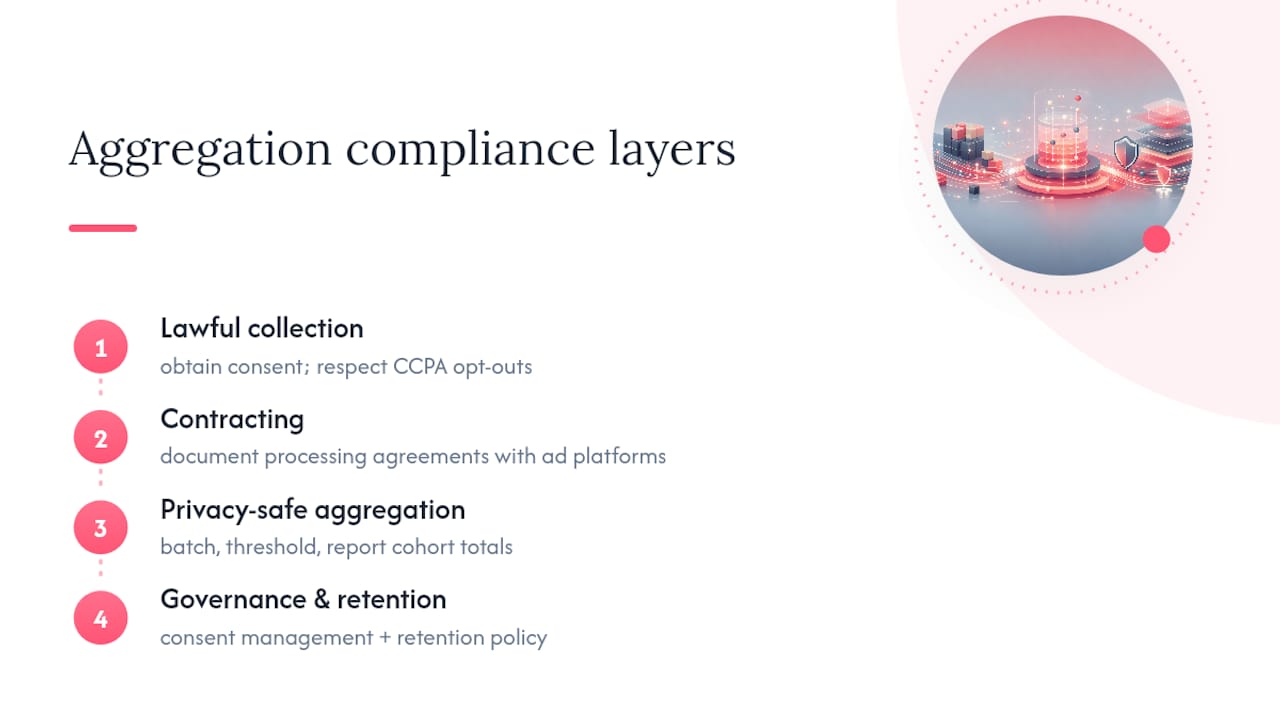
Aggregated event measurement was built for a regulatory environment where individual-level tracking carries real legal exposure, and its core design choices map directly onto what GDPR and CCPA require. Both frameworks restrict processing personal data without a lawful basis and give individuals rights over data tied to their identity. Aggregation sidesteps much of that exposure by design: when events are batched, thresholded, and reported as cohort totals rather than individual records, there's no personal data trail for a regulator, or a plaintiff's attorney, to follow back to one person.
That doesn't make it automatically compliant everywhere. GDPR's rules on legitimate interest and consent still govern how the underlying event data gets collected in the first place, before aggregation ever happens. If a business collects raw event data through cookies or SDKs without proper consent flows, aggregating it downstream doesn't retroactively fix the collection problem. CCPA's opt-out and disclosure requirements apply similarly at the collection layer, not just the reporting layer.
The practical implication for enterprise teams: aggregated event measurement lowers your compliance risk profile substantially compared to user-level tracking, but it doesn't remove the need for a proper consent management platform, documented data processing agreements with ad platforms, and a data retention policy for aggregated outputs. Treat the two as separate layers, lawful collection first, privacy-safe aggregation second, and the whole pipeline holds up under scrutiny far better than treating aggregation alone as a compliance strategy.
How Should Measurement Leaders Operationalize This?
Ownership should sit with a cross-functional team, analytics, media, and finance, not analytics alone. Finance needs a seat because these numbers eventually justify budget, and media needs one because they own the levers being tested.
Start small. Pick your largest or riskiest channel, run one clean incrementality test, reweight attribution with the result, then expand to the next channel once the process proves out. Trying to triangulate every channel simultaneously in month one is how these programs stall.
Governance matters as much as methodology: standardize a test plan template, keep audit logs of every instrumentation change, and retain aggregated outputs long enough to support a full quarter's budget review.
— Tools
How Cassandra Helps You Operationalize This
Cassandra is built to run everything above as one connected workflow instead of three disconnected tools fighting for the same budget conversation. Its Performance Incrementality Dashboard turns test results into the lift and iROAS figures finance actually asks for, while its Geo-Lift Incrementality Testing Platform handles holdout sizing and validity checks automatically, so your team isn't hand-building spreadsheets to sanity-check statistical power.
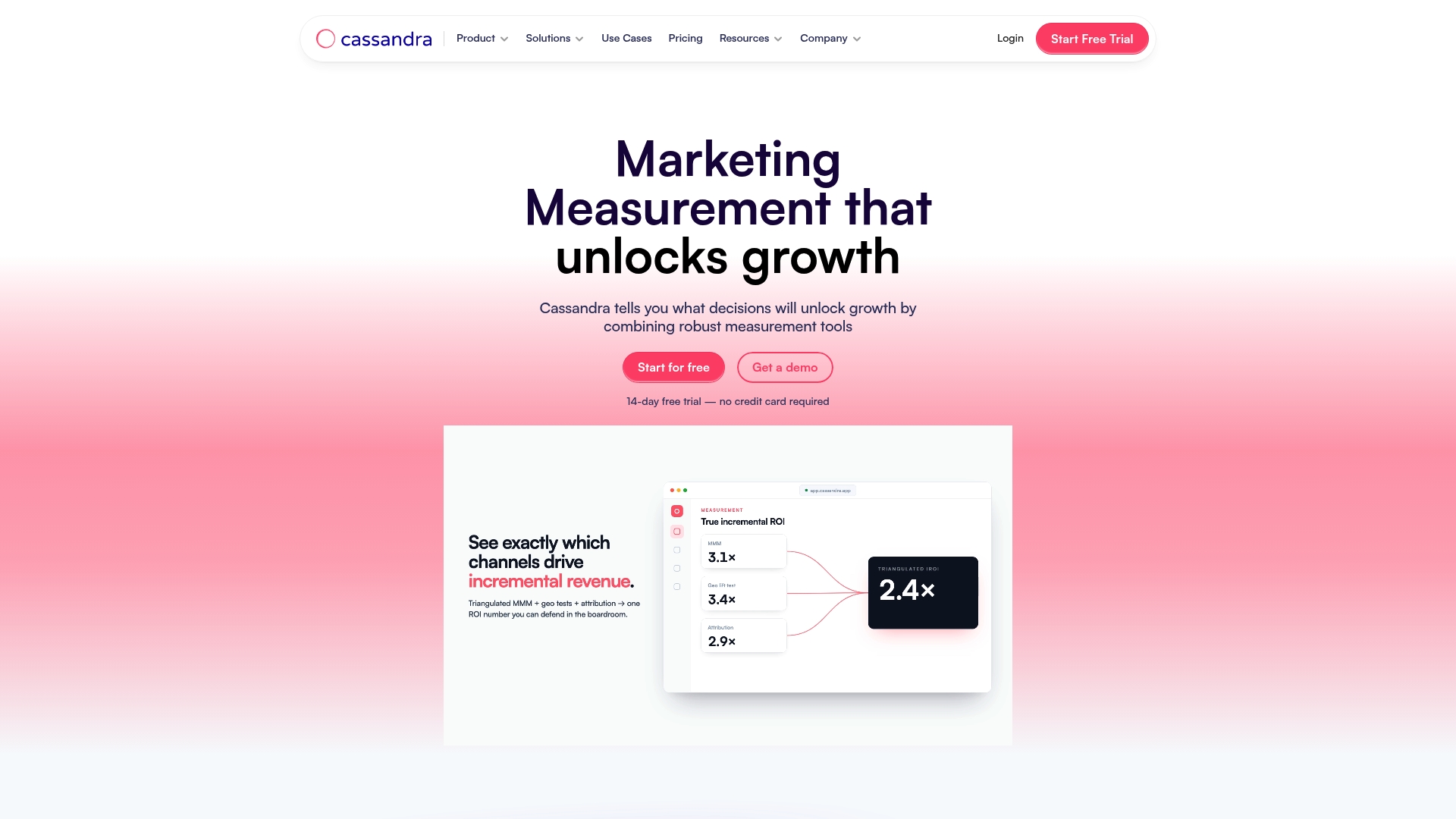
Where a standalone attribution tool leaves you guessing how much to trust its numbers, Cassandra pairs that attribution layer with MMM integrations and live incrementality data, so every dashboard number already reflects a causal check rather than a raw platform claim. For teams evaluating a first pilot, the fastest path in is picking one channel and running it through Cassandra's geo-lift incrementality testing platform before expanding stack-wide. Browse measurement use cases across industries to see how teams in ecommerce, fintech, and nonprofit structured their first pilot, then request a walkthrough to map your own channel priorities against Cassandra's triangulation workflow.
Sources
- FAQ on incrementality: How to prove your ads actually work in 2026
- Marketing Measurement in 2026: MMM, Attribution & Incrementality | Khalid Hamadeh
- Attribution Reporting API / Aggregatable reports (Privacy Sandbox)
- Incrementality Testing in 2026: A Practical… | AdStellar